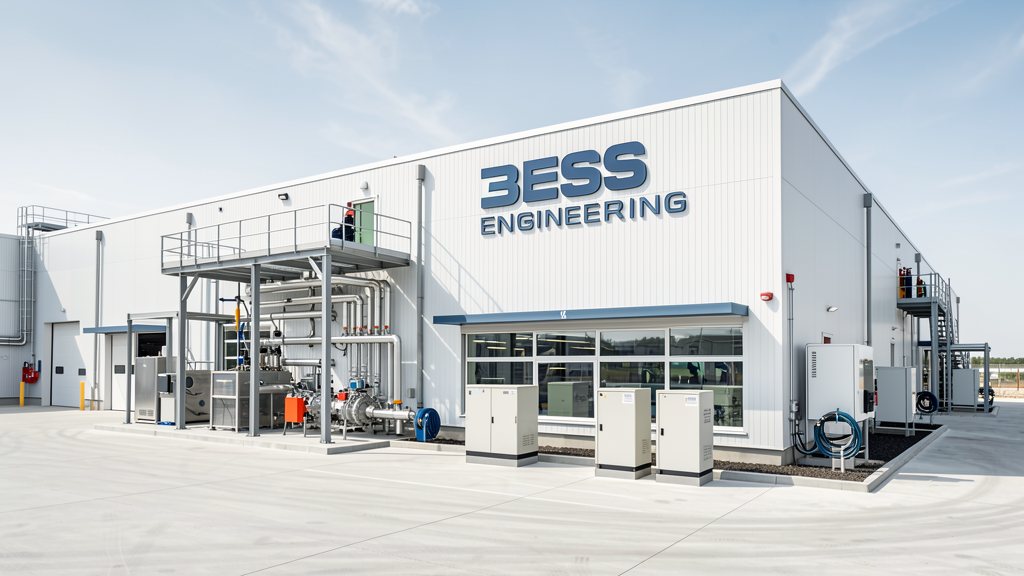
Battery Energy Storage Systems (BESS): technical fundamentals and the Irish grid framework
A utility-scale battery energy storage system is far more than an assembly of electrochemical cells: it is the precise integration of materials chemistry, power electronics, management software, and regulatory compliance. This guide covers the engineering principles governing the design, operation, and grid connectivity of modern BESS, with particular attention to the standards and market rules applicable in Ireland — from IEC 62619:2022 for cell safety to EN 50549 for grid connection and the I-SEM market access requirements that have been progressively unlocked since the SDP-02 reform of November 2025. All regulatory and normative claims are cited to a published source IEC 62619:2022 Ed. 2.0 — Secondary lithium cells and batteries for use in industrial applications (IEC Webstore)EirGrid — FASS Programme: System Services Code Plain English Version (December 2025 draft)SEMO — I-SEM Market Structure: DAM, IDM, Balancing, CRM; T-4 2028/29 Auction ResultsIEEE 1547-2018 — Standard for Interconnection and Interoperability of Distributed Energy Resources (IEEE Xplore). For complementary market context, see the Irish regulatory summary at /ie/rules/ and the grid quality indicators at /ie/gridquality/.
Cell chemistry: LFP versus NMC
The choice of cell chemistry is the most consequential design decision in a long-life BESS. The utility-scale stationary storage market is dominated by two lithium-ion families: lithium iron phosphate (LFP) and lithium nickel manganese cobalt oxide (NMC). Each offers a distinct trade-off among energy density, intrinsic safety, cycle life, and cost per cycle — a trade-off with direct implications for project economics over the ten-to-twenty-year asset life typical of Irish grid-connected storage projects.
LFP: moderate energy density, exceptional thermal stability, and long cycle life
LFP cells (LiFePO₄) operate at a nominal cell voltage of 3.2 V and offer gravimetric energy densities of approximately 90–160 Wh/kg — lower than NMC but combined with an intrinsic thermal stability that makes LFP the dominant chemistry for stationary grid applications. The onset temperature for self-sustaining thermal runaway in LFP cells is in the range of 270–300 °C, substantially higher than NMC (~150–210 °C) or NCA (~150 °C). At an 80–90% depth of discharge, typical cycle life exceeds 4,000–6,000 full cycles before capacity falls below 80% of the nominal rating, equivalent to more than ten to fifteen years of daily cycling. These characteristics — safety, predictable degradation, and long cycle life — make LFP the reference chemistry for utility-scale storage in Ireland and across Europe, where long asset lives and bankability are prerequisites for project financing IEC 62619:2022 Ed. 2.0 — Secondary lithium cells and batteries for use in industrial applications (IEC Webstore).
NMC: higher energy density, lower thermal safety margin
NMC cells (LiNiMnCoO₂) achieve gravimetric energy densities of 150–250 Wh/kg and nominal cell voltages of 3.6–3.7 V. These characteristics make them attractive where physical volume is a binding constraint or where high specific power is required. However, the thermal runaway onset temperature is considerably lower — typically 150–210 °C depending on the precise NMC formulation — which demands more active BMS thermal protection and specific fire suppression design per IEC 62933-5-2. Typical cycle life at deep discharge is approximately 1,500–3,000 cycles, with accelerated degradation at ambient temperatures above 35 °C. IEC 62619:2022 Ed. 2.0 IEC 62619:2022 Ed. 2.0 — Secondary lithium cells and batteries for use in industrial applications (IEC Webstore) includes thermal runaway propagation test procedures applicable to both LFP and NMC chemistries; the second edition introduced laser-ignition methods to simulate single-cell triggering with greater reproducibility than prior test approaches.
Depth of discharge and C-rate: the two defining operational parameters
Depth of discharge (DoD) expresses the fraction of nominal capacity extracted per cycle. Consistent operation above 90% DoD accelerates degradation in all chemistries; manufacturers typically size installed capacity with a 10–15% margin over warranted usable energy to absorb calendar and cycle degradation over the contractual asset life. The C-rate quantifies power relative to capacity: a 1C rate fully charges or discharges the battery in one hour; 0.5C in two hours; 2C in thirty minutes. A 1 MW / 2 MWh BESS operates at 0.5C in energy arbitrage mode and can respond at 1C or above for short-duration frequency response services. Sustained high C-rates cause lithium metal deposition stress on the graphite anode and non-linear degradation; warranty contracts typically cap the maximum permitted C-rate and the number of annual equivalent full cycles.
BMS, bidirectional PCS inverters, and round-trip efficiency
The power electronics of a BESS comprise two tightly coupled functional layers: the Battery Management System (BMS), which monitors and protects cells at the electrochemical level, and the Power Conversion System (PCS) or bidirectional inverter, which conditions energy between the battery's DC bus and the AC grid. The quality of their integration determines the system's real-world efficiency and its ability to satisfy Irish grid connection requirements under EN 50549 and the I-SEM technical registration conditions.
BMS: protection, cell balancing, and state estimation
The BMS operates across three hierarchical levels: cell level (monitoring of individual cell voltage, temperature, and current), module level (passive or active balancing between cells), and system level (communication with the PCS and plant SCADA). Critical protection functions include: over-voltage cut-off (typically above 3.65 V for LFP cells), under-voltage protection (below 2.5 V for LFP), short-circuit current limiting, and active thermal management interfacing with the container HVAC. State-of-charge (SoC) estimation combines current integration (coulomb counting) with open-circuit voltage (OCV) model correction; target accuracy is ±2–3% in steady-state. IEC 62619:2022 Ed. 2.0 IEC 62619:2022 Ed. 2.0 — Secondary lithium cells and batteries for use in industrial applications (IEC Webstore) requires functional verification of the BMS as part of system safety testing, including validation of protection cut-off under overcharge conditions and demonstration that thermal runaway does not propagate to adjacent cells under a laser-triggered single-cell event.
PCS bidirectional inverters: four-quadrant operation and grid quality requirements
The Power Conversion System of a utility BESS is a four-quadrant bidirectional inverter: it can absorb or inject both active power (P) and reactive power (Q). This capability is fundamental to participation in voltage regulation ancillary services within the I-SEM framework. EN 50549-1:2019 EirGrid — FASS Programme: System Services Code Plain English Version (December 2025 draft) defines grid connection requirements for generating plants connected in parallel to low-voltage distribution networks (Type A and B, up to 11 kW); EN 50549-2:2019 applies to medium-voltage plants and imposes Low Voltage Ride-Through (LVRT) capability, harmonic injection limits, and island detection via frequency and voltage measurement. The IEC 61000 series specifies electromagnetic compatibility (EMC) requirements including current harmonic emission limits under IEC 61000-3-12. Modern PCS units achieve peak conversion efficiencies of 97–98.5%, such that the round-trip AC-AC system efficiency (cell + BMS + PCS + transformer losses) typically falls in the 85–93% range, with the higher end of the range achieved in transformerless architectures SEMO — I-SEM Market Structure: DAM, IDM, Balancing, CRM; T-4 2028/29 Auction Results.
Communications: Modbus RTU, SunSpec TCP, and I-SEM dispatch interfaces
Interoperability between inverters, BMS units, meters, and plant SCADA is built on three communication layers. Modbus RTU over RS-485 remains the most widely deployed field protocol, with latencies of 50–200 ms that are acceptable for dispatch-level control. SunSpec Alliance has defined a normalised Modbus TCP register map covering battery parameters (Model 802: SoC, SoH, DC voltage, current, temperature) and inverters (Models 101–103); its reference in IEEE 1547-2018 IEEE 1547-2018 — Standard for Interconnection and Interoperability of Distributed Energy Resources (IEEE Xplore) has accelerated adoption as the sector's interoperability lingua franca. For integration with I-SEM markets and aggregator optimisation platforms, advanced systems expose REST/JSON APIs with authenticated access to real-time telemetry and control setpoints (P and Q), enabling an external optimiser to make dispatch decisions at one-minute or sub-minute resolution. EirGrid and SONI require registered BESS units to implement IEC 61968/IEC 61970 (the Common Information Model) for data exchange with TSO systems; secure communication (TLS 1.2+, mutual authentication) is a standard requirement for units participating in the I-SEM Balancing Market.
Revenue stacking in Ireland: how a 1 MW / 2 MWh BESS operates in the I-SEM
The Integrated Single Electricity Market (I-SEM), operated by EirGrid, SONI, and SEMO, offers a portfolio of revenue streams for a registered BESS. Following the SDP-02 scheduling and dispatch reform of November 2025, batteries can for the first time participate fully in the Day-Ahead Market, the three intraday auctions and continuous intraday trading, the Balancing Market, the DS3 (transitioning to FASS/DASSA) system services programme, and the Capacity Remuneration Mechanism (CRM). Market participants describe this portfolio approach as revenue stacking. The macroelectric context is material: curtailment costs reached €567 million in 2024/25, and modelling by GridBeyond suggests that a 10 MW/2-hour battery accessing the full I-SEM suite can achieve 12–37% higher annual revenue versus relying solely on legacy system services SEMO — I-SEM Market Structure: DAM, IDM, Balancing, CRM; T-4 2028/29 Auction Results. See Market rules for the full regulatory framework and Grid quality for historical SNSP and curtailment indices.
Day-Ahead and intraday arbitrage: the half-hourly value window
In Day-Ahead price arbitrage, the BESS charges during low-price half-hours (typically overnight and early morning, or at midday when high wind generation suppresses prices) and discharges during high-price half-hours (morning ramp, evening peak, or periods of gas-fired generation dominance). A 1 MW / 2 MWh BESS operating at 85% DoD has 1.7 MWh of usable energy per cycle. If the average charge/discharge half-hourly spread is €50/MWh and the system executes one full daily cycle at 88% round-trip efficiency, the illustrative gross arbitrage revenue is approximately: 1.7 MWh × €50/MWh × 0.88 ≈ €74.80 gross per cycle, before operating costs, degradation, and network charges. A distinctive feature of the Irish price stack is that half-hourly spreads average approximately €103/MWh and remain broadly stable across wind penetration levels from 25% to 70%, because the Irish generation stack moves directly from near-zero-cost renewables to expensive gas peakers, with virtually no intermediate thermal plant to moderate the price signal SEMO — I-SEM Market Structure: DAM, IDM, Balancing, CRM; T-4 2028/29 Auction Results. These figures are illustrative of the calculation methodology; actual revenue depends on I-SEM prices on each trading day.
System services: DS3 transition to FASS and the DASSA competitive auction
Ireland's DS3 (Delivering a Secure, Sustainable Electricity System) programme has provided fixed regulatory tariffs for frequency response and reserve products — Fast Frequency Response (FFR), Primary Operating Reserve (POR), Secondary Operating Reserve (SOR), Tertiary Operating Reserve (TOR1/TOR2), and Replacement Reserve (RR) — since 2017, building the first wave of the Irish battery fleet on predictable ancillary revenue. DS3 tariffs have fallen by more than 40% in effective value since 2022 as base rates were reduced and multipliers cut. The replacement framework, FASS, centres on the Day-Ahead System Services Auction (DASSA), in which batteries will bid daily per service per 30-minute trading period, with all-island clearing prices and secondary trading permitted up to 90 minutes before delivery. DASSA is targeted for go-live in May 2027 EirGrid — FASS Programme: System Services Code Plain English Version (December 2025 draft), with DS3 regulated tariffs extended as a transitional bridge by SEM Committee decision in June 2025. A 1 MW BESS can bid frequency response products symmetrically (500 kW up, 500 kW down), provided the PCS can reach its target output within the response time specified for each product — typically 2 seconds for FFR, 10 seconds for POR.
The Capacity Remuneration Mechanism and BESS de-rating
Ireland's CRM provides multi-year capacity payments, with T-4 auctions held four years ahead of the delivery year and T-1 auctions one year ahead. Battery storage qualifies as a capacity provider and has participated in several CRM auction rounds. The December 2024 T-4 auction for 2028/29 cleared at approximately €149,960/MW — more than double Great Britain's equivalent clearing price — and awarded 5,942 MW of capacity agreements SEMO — I-SEM Market Structure: DAM, IDM, Balancing, CRM; T-4 2028/29 Auction Results. For BESS projects, de-rating factors are increasingly material: one-hour and two-hour battery systems have seen their effective capacity credit approximately halve in recent CRM rounds as the SEM Committee updates de-rating methodology to reflect realistic battery discharge duration relative to peak stress periods. Four-hour systems under development for the next investment cycle carry substantially higher de-rating values, supporting a longer bankable CRM revenue stream. Mandatory prequalification applies to dispatchable units above 10 MW; units below that threshold may participate voluntarily. The CRM structure provides revenue certainty up to four years ahead — a bankable cash flow stream that can materially improve project debt coverage ratios alongside the more variable wholesale and ancillary revenue layers.
Applicable standards, cell degradation, and project performance guarantees
The design life of a utility BESS — typically ten to twenty contractual years — demands not only an appropriate cell chemistry selection but also active degradation management and sustained regulatory compliance. The IEC and EN standards applicable to Irish grid-connected BESS establish safety testing requirements, power quality obligations, and communication interface specifications that constrain design from the cell to the grid connection point. Performance guarantees, underpinned by these standards, are the contractual instrument through which the cell degradation risk is allocated between asset owner and manufacturer.
IEC 62619:2022 and the IEC 62933 series: safety and system testing
IEC 62619:2022 Ed. 2.0 IEC 62619:2022 Ed. 2.0 — Secondary lithium cells and batteries for use in industrial applications (IEC Webstore) is the reference safety standard for lithium cells and batteries in stationary industrial applications. It covers four test families: electrical safety (overcharge, over-discharge, external short-circuit, forced discharge), mechanical safety (vibration, shock, drop), environmental safety (high-temperature exposure, thermal cycling), and system-level safety (BMS protection verification, thermal runaway propagation testing). The second edition introduced laser ignition methodology for triggering individual cells, replacing less reproducible prior methods. Complementarily, the IEC 62933 series addresses the functional and safety requirements of electrical energy storage (EES) systems as complete installations: IEC 62933-1 defines terminology and general requirements; IEC 62933-2-1 covers unit-level performance requirements; IEC 62933-5-2 specifies safety requirements for electrochemical-based EES systems at the room or container level, including fire suppression system design and gas detection requirements. Both standards are referenced in Irish grid connection consent processes administered by EirGrid and the Distribution System Operators (ESB Networks and others) EirGrid — FASS Programme: System Services Code Plain English Version (December 2025 draft).
Capacity degradation: mechanisms, models, and performance warranties
Capacity degradation in LFP cells follows a non-linear curve: the first 200–500 cycles exhibit an initial capacity drop of 2–5% (often termed 'seasoning' or 'formation stabilisation'), followed by a slow-degradation plateau (approximately 0.02–0.05% per cycle) that can steepen again in the end-of-life phase (the 'knee point'). The dominant degradation mechanisms are: active lithium loss (LAM) through SEI layer growth on the graphite anode, electrolyte decomposition, and gradual cathode particle cracking. At the contractual level, utility BESS projects typically carry performance guarantees committing to maintain at least 80% of initial capacity over the first ten years or a specified number of equivalent full cycles (whichever comes first). The operator tracks degradation through periodic SoH (State of Health) assessments benchmarked against the factory commissioning capacity. Cell operating temperature is the dominant degradation stress factor: each 10 °C increase above the 25 °C reference temperature approximately doubles the degradation rate (Arrhenius law), making the battery thermal management system (BTMS) the critical long-term reliability asset of the installation IEC 62619:2022 Ed. 2.0 — Secondary lithium cells and batteries for use in industrial applications (IEC Webstore).
EU and Irish grid connection compliance: EMD 2024 and storage de-charging rules
The EU's reformed Electricity Market Design package — Regulation (EU) 2024/1747 and Directive (EU) 2024/1711 — explicitly requires member states to exempt storage from double network charges and to facilitate revenue stacking across all wholesale market segments IEEE 1547-2018 — Standard for Interconnection and Interoperability of Distributed Energy Resources (IEEE Xplore). Ireland's CRU April 2026 minded-to decision on network charges is partly driven by Article 6 of Regulation (EU) 2019/943 (as amended), which mandates exemption from Demand TUoS for storage units. For BESS project developers, this regulatory trajectory means that financial models built in 2024 using conservative charging-cost assumptions should be revisited: the reclassification from D-TUoS to G-TUoS treatment from October 2026 removes approximately €30/MWh from each charge cycle and is projected to increase storage utilisation by approximately 30% according to the independent modelling cited in the CRU's decision IEEE 1547-2018 — Standard for Interconnection and Interoperability of Distributed Energy Resources (IEEE Xplore). Grid connection consent for transmission-connected storage (above approximately 10 MW) is governed by EirGrid's Enduring Connection Policy (ECP-2), which now formally allows co-located hybrid storage and generation projects to share a single Maximum Export Capacity allocation EirGrid — FASS Programme: System Services Code Plain English Version (December 2025 draft).
- IEC 62619:2022 Ed. 2.0 — Secondary lithium cells and batteries for use in industrial applications (IEC Webstore)
- EirGrid — FASS Programme: System Services Code Plain English Version (December 2025 draft)
- SEMO — I-SEM Market Structure: DAM, IDM, Balancing, CRM; T-4 2028/29 Auction Results
- IEEE 1547-2018 — Standard for Interconnection and Interoperability of Distributed Energy Resources (IEEE Xplore)
- European Commission — EMD Reform Package: Regulation (EU) 2024/1747 and Directive (EU) 2024/1711
Designing or evaluating a BESS project in Ireland?
Our arbitrage analysis and system services tools allow you to model the expected performance of your storage system using real I-SEM price data, historical SNSP curtailment profiles, and Irish CRM capacity clearing prices. See also the regulatory framework at <a href='/ie/rules/'>/ie/rules/</a> and grid quality indicators at <a href='/ie/gridquality/'>/ie/gridquality/</a>.
Lohnt sich ein Speicher fuer dich?
Rechne mit echten Preisen aus, was ein Batteriespeicher pro Jahr bringt.
Speicher-Wert berechnen →