204 MW on Berlin's Doorstep – Can Wustermark Join the AI League?
Brandenburg as the next digital frontier
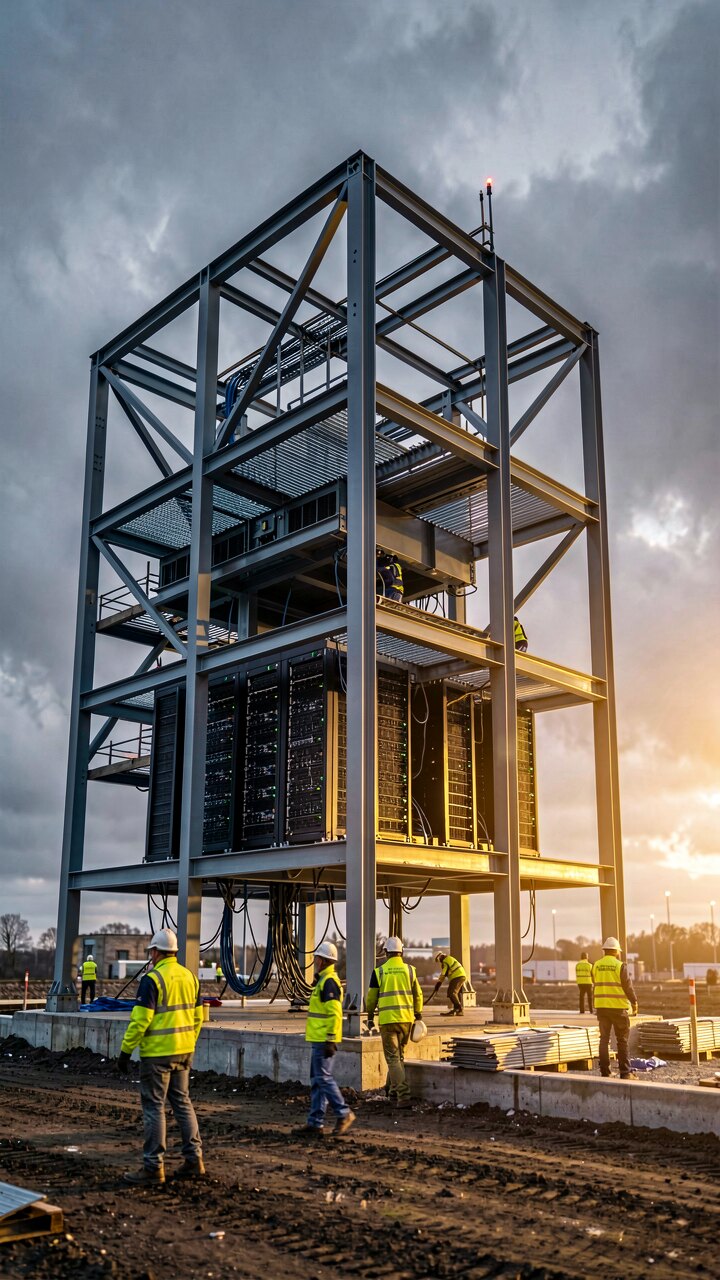
Wustermark is not a place that immediately suggests "digital epicenter." A small town west of Berlin, better known for the A10 motorway and a nearby motorsport arena than for fiber hubs or network exchanges. And yet, the most ambitious new datacenter project in Germany is currently taking shape here: the VIRTUS Wustermark Campus, with a planned power capacity of 204 megawatts.
VIRTUS Data Centres, the British operator with a strong presence in London, did not choose this location by chance. Berlin has established itself as Germany's second most important metropolitan region for cloud infrastructure – after Frankfurt, the traditional FLAP-D cluster anchor. The Berlin market is growing, driven by startups, AI laboratories, government agencies, and mid-sized companies that need local data hosting. Wustermark offers the decisive combination: space, grid connection, and proximity to the German capital without the density and costs of an urban site.
What greenfield really means
When a datacenter is built as a greenfield project, it means no legacy building, no retrofitted warehouse, no compromises imposed by old infrastructure. Every transformer substation, every cooling loop, every cable tray is designed from scratch. This enables optimal efficiency – and creates maximum complexity during the planning phase.
204 MW greenfield means VIRTUS must dimension a cooling infrastructure that is compatible with modern AI racks from day one. GPU servers of the latest generation produce rack power densities of 40 to over 100 kW per rack – compared with 5 to 10 kW per rack in conventional enterprise datacenters. Direct liquid cooling at the rack is no longer optional for these densities; it is mandatory. The HVAC system must therefore work on multiple levels simultaneously: removing heat from liquid cooling loops, extracting residual heat from server room air, and separately conditioning infrastructure spaces (power supply, networking, UPS).
Germany and AI infrastructure: a quiet race
Frankfurt dominates the FLAP-D group – Frankfurt, London, Amsterdam, Paris, Dublin – as the anchor for existing hyperscaler cloud regions. But the growth of the next wave is happening at new sites. The reasons are pragmatic: at established nodes, land is scarce, permits are delayed, and grid connections are expensive. Wustermark offers what Frankfurt can no longer deliver: space for large projects without years of regulatory battles.
This is politically significant. Germany has spent years debating AI sovereignty, European cloud independence, and where the critical computing infrastructure of the future should be located. The VIRTUS campus at Wustermark is a concrete answer to that debate – not a policy paper, but steel and copper.

HVAC at a new scale: what 204 MW demands in cooling
A campus of this size requires a total thermal cooling capacity that begins to approach the scale of a district heating network for a medium-sized city. The cooling systems typically include multiple large dry coolers on the roof, pump groups in the basement, distribution loops through the entire building, and a powerful building management system that monitors and controls all components in real time.
The problem: in practice, many of these systems lack sufficient transparency. Operators often know how much electricity their datacenter consumes in total – but not how much is attributable to which HVAC unit, whether a particular chiller is running inefficiently, or where thermal hotspots are forming. This blindness costs money and energy.
Stromfee: Transparent HVAC for the datacenter of the future
Stromfee's Transparent HVAC makes visible exactly what has remained in the dark. Through AI-powered monitoring, the platform at apps.stromfee.ai captures per-unit cooling consumption in real time, automatically detects efficiency outliers, and couples HVAC control with the BESS Optimizer – enabling intelligent peak shaving and energy arbitrage when dynamic electricity prices make it worthwhile.
What applies to a 204 MW campus like Wustermark applies at smaller scale to every factory hall, every server room, and every production facility with a complex cooling system: transparency is the first step toward optimization. Without measurement there is no control, without control there is no savings potential.
Wustermark will show whether Germany can make the leap. The infrastructure is being built – now it needs the software that makes this infrastructure truly manageable.
Sources
- BlackRidge Research: Largest & Latest Data Centers in Europe