Asia's AI Twin Engines: How Tokyo and Singapore Each Surpassed 1 GW to Become Global AI Infrastructure Powerhouses
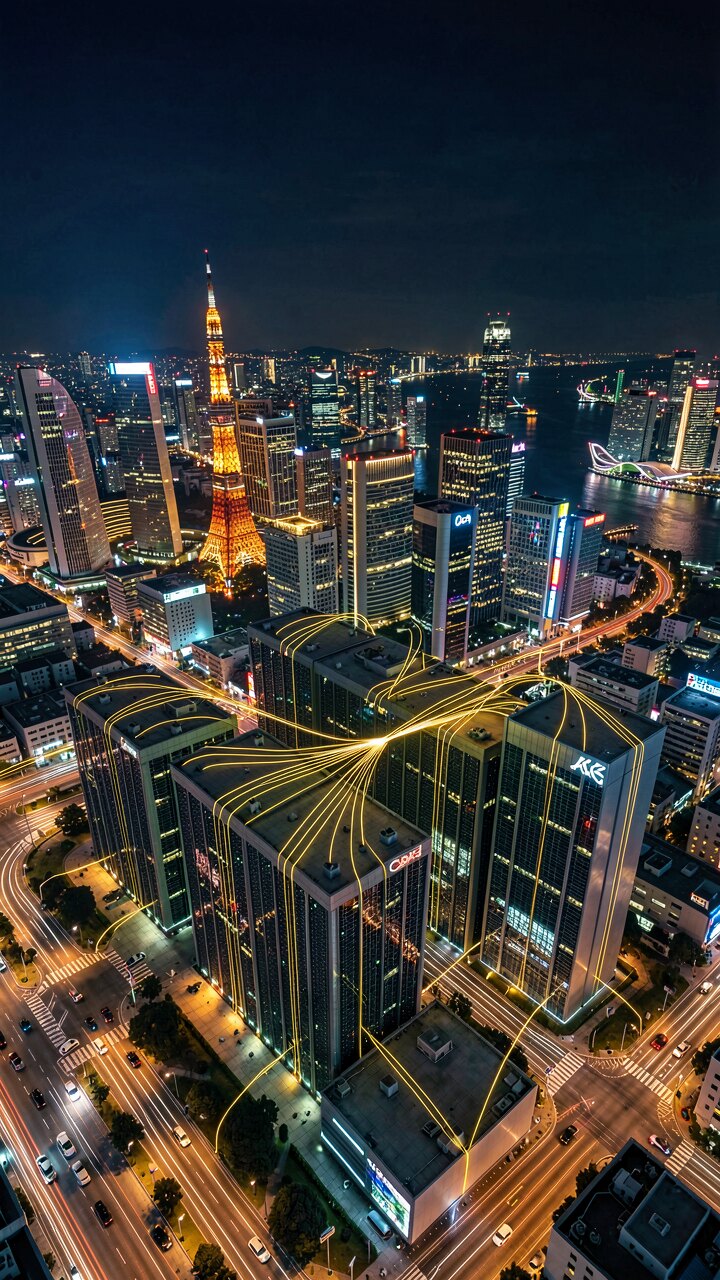
In the world ranking of AI datacenters, most entries belong to single mega-campuses. Rank 25 is different: it belongs not to a single building or a single operator, but to a distributed cluster – the datacenter metropolitan areas of Tokyo and Singapore, Asia's two dominant AI infrastructure hubs. Together they represent over 2 GW of installed total datacenter capacity and are growing faster than any other region outside North America.
Singapore: The Gateway to Southeast Asia
Singapore is the second-largest APAC datacenter market after Sydney. The city-state offers what operators need: political stability, world-class network connectivity (the crossing point of multiple transoceanic subsea cables), English-language administration, and a regulatory environment that attracts large-scale investment. All major hyperscalers have a significant presence: Google, Amazon Web Services (AWS), and Microsoft Azure. Global colocation providers like Equinix and ST Telesystems round out the ecosystem.
Total installed capacity exceeds 1 GW according to industry reports – spread across dozens of buildings in multiple datacenter parks, primarily in the Tuas area and the Jurong Innovation District. Singapore has at times imposed moratoriums on new datacenters because the city-state's energy balance came under pressure – a sign of how seriously capacity constraints are taken.
Tokyo: Japan's Catch-Up Drive
Tokyo is the third-largest APAC market and closing the gap rapidly. Japan has long struggled with comparatively high energy prices and a complex grid structure – but AI demand is overriding these concerns. NTT Data, one of Japan's largest IT groups, operates multiple major campuses in the greater Tokyo metropolitan area. All major hyperscalers have opened their own datacenters in Tokyo Regions.
A distinctive feature of Tokyo: the demand for latency optimization is particularly high here. Japan is a market with strong digital adoption, a major gaming industry, and rapidly growing enterprise AI use. Inference servers need to be close to users – making Tokyo a strategically significant node for delivering real-time AI responses across Asia.
Operator Mix: Hyperscalers and Colocation
What distinguishes the APAC cluster from many other ranking candidates is its fragmentation: there is no single campus, no single operator. Instead, hyperscalers and colocation providers share the load in both cities:
- Google: Own datacenters in Singapore and Tokyo for Google Cloud regions
- AWS: Multiple Availability Zones in both cities, massively expanded since 2022
- Microsoft Azure: Japan East (Tokyo) and Japan West (Osaka), Singapore as its own region
- NTT Data: Largest local operator in Japan with multiple campus sites
- Equinix: Global colocation market leader with strong presence in both Singapore and Tokyo
Energy Profile: Challenges and Solutions
The two cities face different energy challenges. Singapore is an island nation with no domestic hydropower or significant wind resources – electricity comes primarily from natural gas. The city-state is investing in rooftop solar and floating solar panels, but space constraints limit the possibilities. Datacenters in Singapore therefore have a comparatively high carbon footprint per kWh.
Tokyo, in contrast, draws its electricity from a mix of nuclear (partially restarted following post-Fukushima reform), gas, hydro, and increasingly renewable sources. TEPCO, the local grid operator, is investing heavily in grid expansion to serve growing datacenter demand.
For both locations, the same principle applies: liquid cooling and BESS systems are becoming standard infrastructure. The combination of high humidity (Singapore) and urban heat islands (Tokyo) makes efficient HVAC a first-order cost factor at these scales.
Stromfee's Take: What APAC Means for Europe
The APAC cluster sends a clear signal: AI infrastructure is global, energy demand is local. What is being built in Tokyo and Singapore drives global chip demand, subsea cable investments, and energy market prices. For German plant operators, the same principle applies at a smaller scale: whoever optimizes their own PV plant or battery storage needs real-time market intelligence.
That is exactly what stromfee.app provides as a multi-country hub: AI-powered energy market analysis for Germany, Europe, and beyond. What applies as an infrastructure principle in APAC – distributed, multi-operator, latency-optimized – translates into individual plant recommendations for the German and European market.
Optimize your energy costs with Stromfee AI
From Tokyo to the Rhineland – AI infrastructure shapes electricity markets worldwide. Stromfee brings the same intelligence to your PV plant or battery storage system across multiple countries.
Try Stromfee →Conclusion
Rank 25 stands for a principle that will define the future of AI infrastructure: not a single super-site, but a network of distributed clusters that together outperform any individual location. Tokyo and Singapore are already today the hubs through which Asia's AI demand flows. With growing compute capacity, declining latencies, and increasing energy requirements, their role will continue to expand in the coming years.
Sources: Blackridge Research – Largest AI Data Center Companies · Sentisight – Data Center Rankings. Capacity figures (>1 GW per city) per APAC market research reports. All illustrations: AI-generated (FLUX·2).