Stromfee Oceania: Battery Optimisation for the Pacific
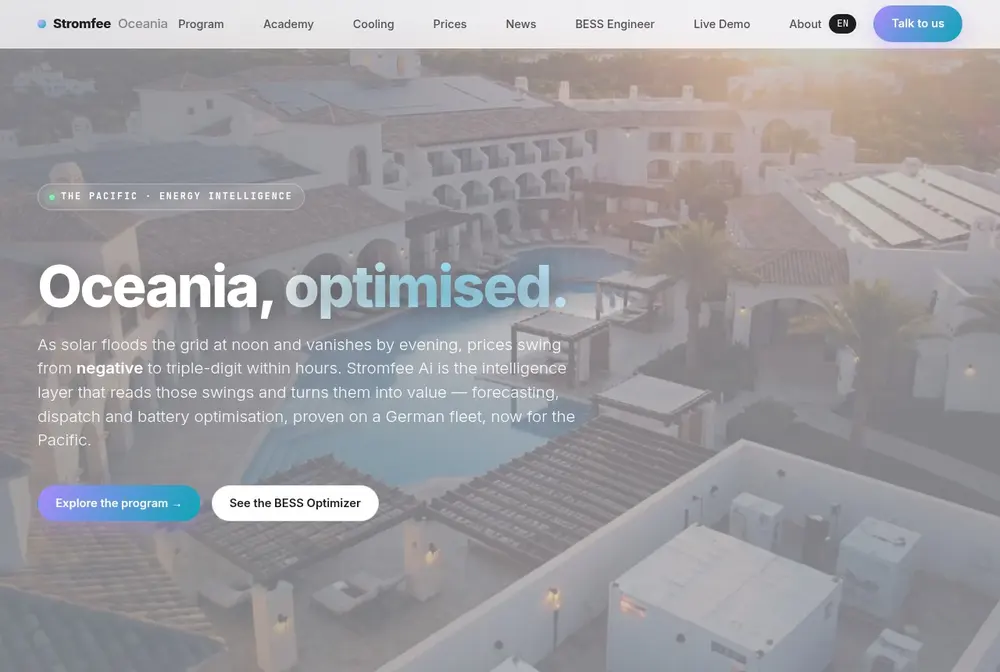
Stromfee Oceania points the platform at Australia and the Pacific islands — some of the most solar-rich, and most volatile, grids in the world. Midday curtailment, steep evening peaks and thin system inertia are the daily reality, and a battery that reads the swing is the lever that turns them into value.
The problem: solar floods noon, scarcity by evening
High solar penetration creates the same shape everywhere: midday over-generation and curtailment, steep evening peaks on ageing thermal plants, and falling system inertia with frequency and voltage stress. On the reference European day-ahead curve of 14 June 2026 the price ran from −25 €/MWh at 13:00 to +112 €/MWh at 20:00 — a 137 €/MWh spread. That swing is the whole opportunity: charge when power is free, discharge when it is scarce.
The solution: the BESS Optimizer
The core is a vendor-agnostic battery-dispatch engine that sits on top of the certified PCS/EMS safety controller — it never replaces it. It charges low, discharges high, and can deliver energy shifting, fast frequency response, peak-shaving, curtailment reduction, voltage support and black start. Dispatch is degradation-aware, so revenue is traded off against the 20-year warranty rather than against it. It speaks 173 manufacturer protocols (Modbus / SunSpec / API).
One intelligence layer, many tools
Behind the regional front page sits a single stack of tools — the same one that runs on the German reference fleet:
Why it is a "glass battery"
Every set-point, every cell voltage and every revenue figure is visible — no black-box dispatch. You see the two numbers that matter side by side: what the battery actually earned, and what the market allowed. For Pacific island systems and mainland operators alike, the glass-box view — actual earnings against the achievable ceiling — is what turns a storage business case into a measurement a financier can stand behind.
Proven where it is hardest
The method was built on the German grid — arguably the world's toughest proving ground for AI battery dispatch, with extreme solar and wind penetration, negative prices, redispatch and frequency stress. Twenty-plus years of operating real generation and storage assets against live markets stand behind it. For the Pacific, the same engine, now pointed at your grid.
The Oceania picture
Australia's National Electricity Market (NEM), run by AEMO on five-minute settlement, is a live preview of a battery-led grid. Since Q3 2024 it added 2,936 MW / 6,482 MWh of new batteries, and by Q1 2026 storage was the most frequent price-setting technology — setting the price in more than 40 % of intervals in New South Wales and Queensland. Negative-price intervals averaged around −A$16/MWh in Q3 2025, and battery discharge helped pull wholesale prices to about A$50/MWh in Q4 2025 (−44 % year on year). Reading that volatility and dispatching against it is the whole game.
The Stromfee regional network
Explore the program at oceania.stromfee.ai, or watch a real battery live at BESS Inside.
Frequently Asked Questions
What does Stromfee Oceania offer?
Stromfee's intelligence layer optimises batteries across Australia and the Pacific, turning solar price fluctuations into revenue.
Is Stromfee’s technology new to battery optimisation?
The technology has been proven on a German fleet before being applied to the Oceania region.
What kind of monitoring does Stromfee provide?
Stromfee offers register-true monitoring alongside forecasting and dispatch capabilities.
Who is the author of this blog post?
Holger Roswandowicz from HR Energiemanagement GmbH authored the post.