Stromfee.US: The Independent Service Layer for Battery Storage
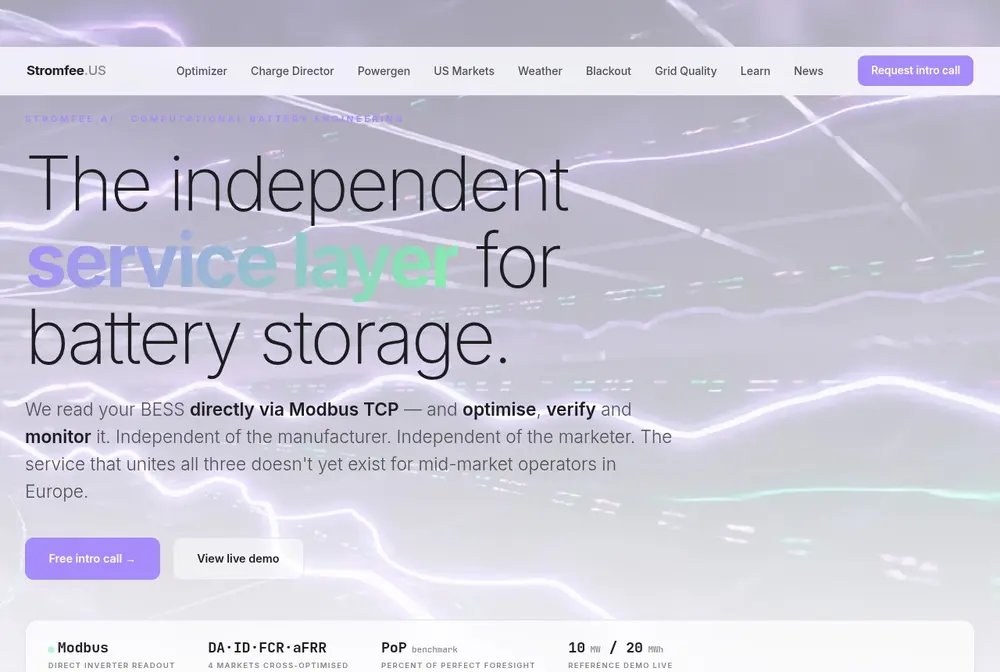
Most battery operators rely on two parties: the company that sold the hardware, and the trader who markets the power. Both hand you their own numbers. What has been missing is an independent third instance that reads the battery itself and checks whether the promise actually arrives. That is what Stromfee.US is built to be.
Optimise · Verify · Monitor
The site frames the service as three jobs brought under one roof, all fed from a direct Modbus TCP read of the asset:
The glass-box demo
The reference asset is a 10 MW / 20 MWh Modbus-connected live twin. On one documented day it charged from 11:00–13:00 at an average of −68.84 €/MWh (negative prices — the market paying to absorb power) and discharged 18:00–20:00 at 152.12 €/MWh: a 220.96 €/MWh spread and about €4,175 for the day, executed by writing the EMS strategy straight into registers 40011–40109. The AI recomputes the plan roughly every 38 seconds.
The gap it targets
A real 1.5 MW storage site in northern Germany captured only 42 % of the achievable revenue in one billing month. The remaining 58 % is not fate — it is measurable, and therefore negotiable. Across the German register alone, Stromfee counts 1,160 BESS units ≥ 1 MW totalling 24.7 GW (542 operational, 596 planned). That is the address space for an independent service layer.
Beyond the battery
Stromfee.US also carries market-side pages a US-facing operator asks for: US Markets, a Powergen view, Weather, Blackout and Grid Quality, plus a Learn section and its own news feed. The verification method is deliberately the same everywhere — a neutral, register-true number you can take to a bank, a board or an investor.
The US picture
The United States is the world's most active battery-arbitrage proving ground. In CAISO, storage grew from about 500 MW in 2020 to more than 13 GW by early 2025, while below-zero prices ran roughly 1,180 hours in 2024 — about 13 % of all hours — as midday solar overwhelmed demand. ERCOT roughly tripled its fleet between 2023 and 2025 to near 10 GW, and its net-demand peak has slid from 5 pm to 9 pm as solar reshapes the curve. Different markets, one pattern: the value sits in the swing, and it is measurable. That is exactly what a register-true capture rate quantifies.
The Stromfee regional network
See it live at stromfee.us, or take the glass-box tour at BESS Inside.