How Much Power the Biggest Football Stadiums Consume — the 2026 World Cup Energy Report
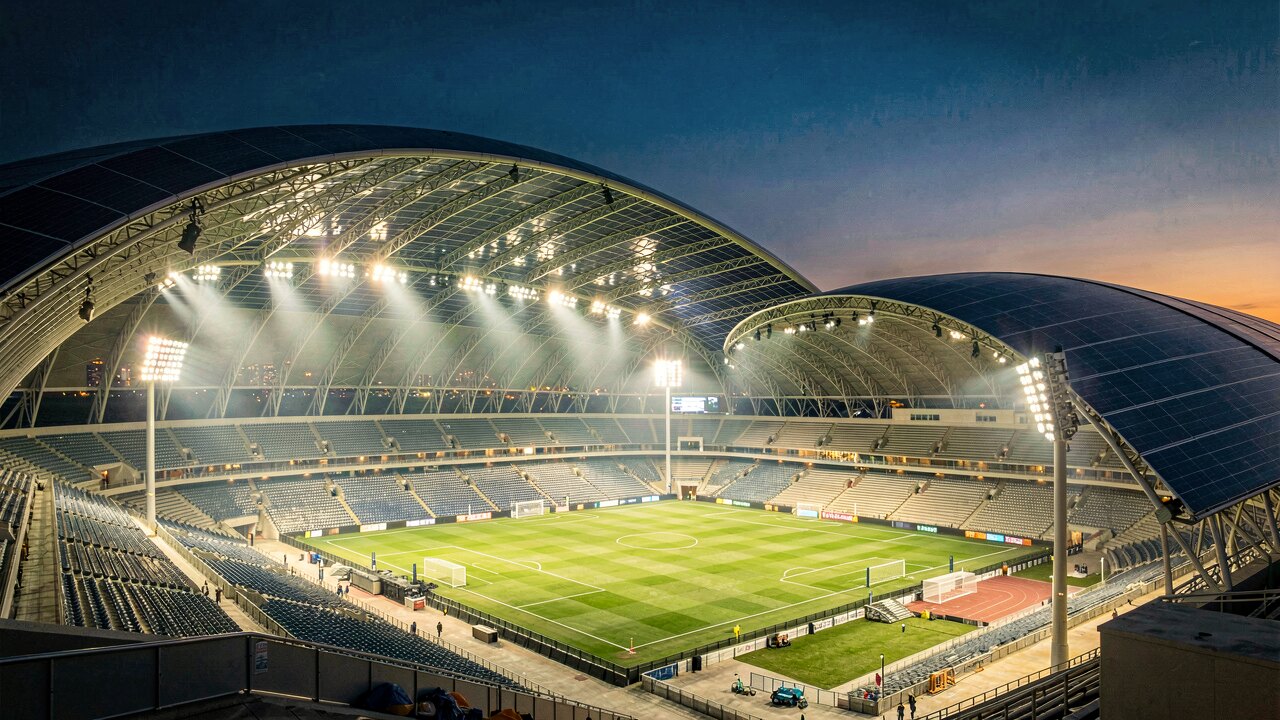
On June 11, 2026, the largest Football World Cup in history began: 48 teams, 104 matches, for the first time three host nations — USA, Mexico and Canada — and 16 stadiums. We are not looking at the goals, but at the meter behind them. Because a full stadium is one of the densest electricity loads a city connects to the grid for a few hours.
For context: these up to 10 megawatts of peak demand correspond roughly to the simultaneous connection of a small industrial area — concentrated into a few hours around kick-off. Over an entire year, a large stadium consumes as much electricity as a small town. The figures come from industry surveys of US professional stadiums; they vary considerably depending on climate, roof type and event density.
Where the Appetite Comes From
The lion's share is drawn by four items: the floodlights, air conditioning (in hot or enclosed arenas often the largest annual consumer — figures on the order of 15 MWh for a matchday are cited for cooling alone), the large LED video walls and catering with their large kitchens and cold storage. In cooler countries, pitch heating adds to this; in enclosed bowls, grow lighting for natural turf. We are currently preparing precisely this ranking of the largest stadium consumers as a dedicated short-film series.
The most important efficiency story of recent years: the switch from halogen metal halide floodlights to LED. It has drastically reduced lighting consumption — and incidentally delivered broadcast-quality, instantly switchable light.
The Solar Champions Among the World Cup Stadiums
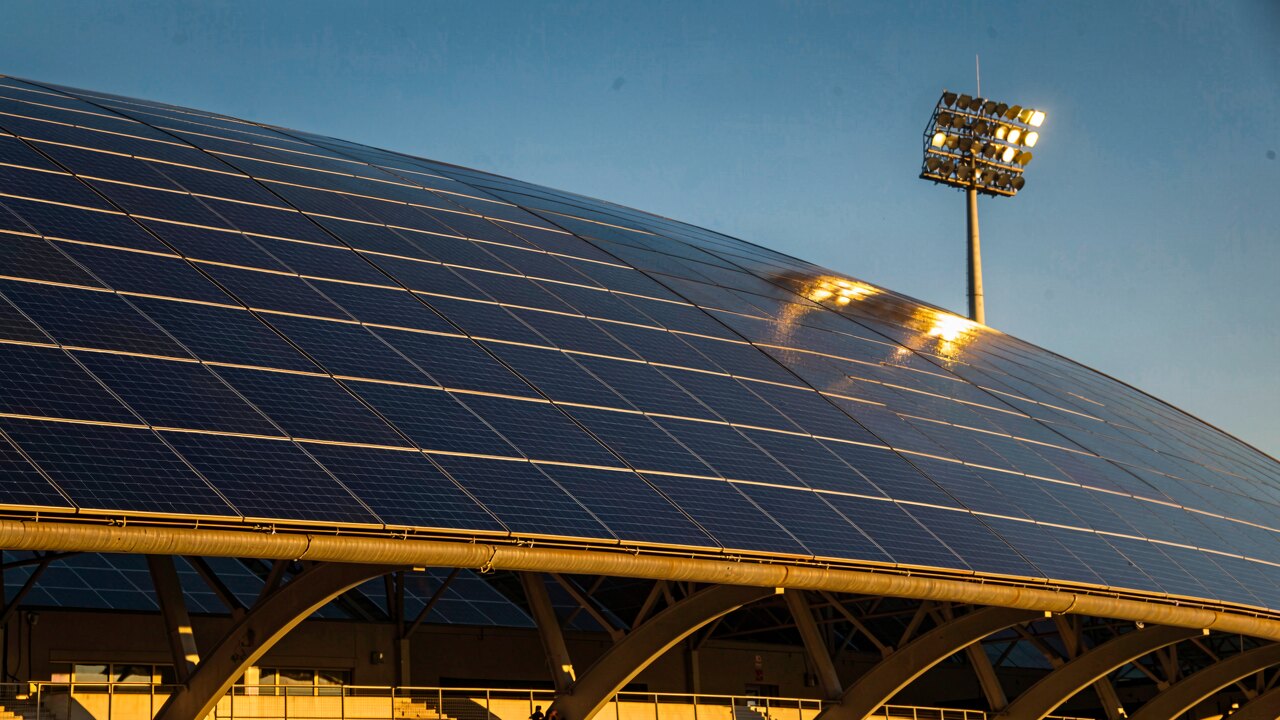
Several host arenas generate a portion of their electricity themselves. The range is wide — from a symbolic gesture to a serious installation:
- Mercedes-Benz Stadium, Atlanta — the first LEED Platinum professional stadium in the USA. Approximately 4,000 solar modules deliver over 1,600 MWh per year — calculated to be enough for more than nine Atlanta Falcons home games.
- Lumen Field, Seattle — 3,750 modules on approximately one hectare of roof, over 830 MWh per year, plus "TRUE Gold" for exemplary waste reduction.
- Levi's Stadium, San Francisco Bay Area — 1,186 modules plus a 400 kW fuel cell; calculated over the year, the solar installation covers all home games.
- MetLife Stadium, New York/New Jersey — the final venue carries a visible solar "Ring" of 1,350 modules (approximately 350 kW) around the roof — the only US stadium with roof-integrated PV in this encircling form.
Not every arena opts for its own roof: SoFi Stadium in Los Angeles has a translucent ETFE roof with little roof-mounted PV — the operators instead cover their consumption through 100% green energy certificates. Both are legitimate approaches; they just read the electricity bill differently.
The German World Record as a Benchmark
The world's currently most powerful stadium solar roof is not in the USA, but in Germany: on the roof of Borussia Dortmund's Signal Iduna Park — the country's largest stadium — BVB and RWE commissioned an installation with 11,132 modules and over 5 megawatts of peak output in November 2025. It is the most powerful PV installation ever installed on a stadium roof. The benchmark against which the World Cup arenas must measure themselves therefore comes from the Bundesliga.
All 16 World Cup 2026 Stadiums at a Glance
During the tournament, many arenas carry neutral FIFA names for sponsorship reasons (e.g. "New York New Jersey Stadium"). Capacities rounded; may vary slightly depending on World Cup configuration.
AT&T Stadium · Dallas/Arlington
The largest World Cup stadium, with a retractable roof and one of the NFL's most massive video walls. Air conditioning and the large display drive the load.
Solar: no significant rooftop PVMetLife Stadium · New York/New Jersey
Final venue. Carries a visible solar "ring" around the roof.
Solar: 1,350 modules · ~350 kWMercedes-Benz Stadium · Atlanta
First LEED Platinum professional stadium, iconic ring video board. Solar flagship project.
Solar: 4,000 modules · >1,600 MWh/yearArrowhead Stadium · Kansas City
One of the loudest open bowls in the NFL. Classic floodlight profile without a roof.
Solar: no significant rooftop PVNRG Stadium · Houston
First NFL stadium with a retractable roof. In the Texas summer, air conditioning is the top consumer.
Solar: no significant rooftop PVLevi's Stadium · San Francisco Bay Area
NFL solar pioneer, LEED Gold. PV plus fuel cell.
Solar: 1,186 modules + 400 kW fuel cellSoFi Stadium · Los Angeles
Translucent ETFE roof, "Infinity" double video wall. Consumption covered via green energy certificates.
Solar: 100% green energy certificatesLincoln Financial Field · Philadelphia
Early renewables pioneer in the league with roof/facade solar and small wind turbines.
Solar: PV + wind turbines on the buildingLumen Field · Seattle
Large-scale rooftop PV over approximately one hectare, award-winning waste management.
Solar: 3,750 modules · >830 MWh/yearHard Rock Stadium · Miami
Distinctive canopy against heat and rain — correspondingly high cooling demand; solar carports on the premises.
Solar: solar carports on siteGillette Stadium · Boston/Foxborough
Adjacent solar and storage park ("Patriot Place") supplies the entire area.
Solar: solar park + storage on siteEstadio Azteca · Mexico City
Opening match. The only stadium with three World Cup appearances (1970, 1986, 2026), at 2,200 m altitude.
Solar: modernised (LED), no large rooftop PVEstadio BBVA · Monterrey/Guadalupe
"El Gigante de Acero" — the steel giant with a spectacular mountain backdrop.
Solar: no significant rooftop PVEstadio Akron · Guadalajara/Zapopan
Landscaped earth mound design, considered one of Mexico's more sustainable stadiums.
Solar: no large rooftop PVBC Place · Vancouver
World's largest retractable cable-net roof, energy modernisation (LED, efficiency). Temporary natural turf installed for the World Cup.
Solar: efficiency modernisation rather than rooftop PVBMO Field · Toronto
Open stadium with natural turf, expanded for the World Cup. Ontario's power grid is strongly hydro and nuclear-based.
Solar: no significant rooftop PV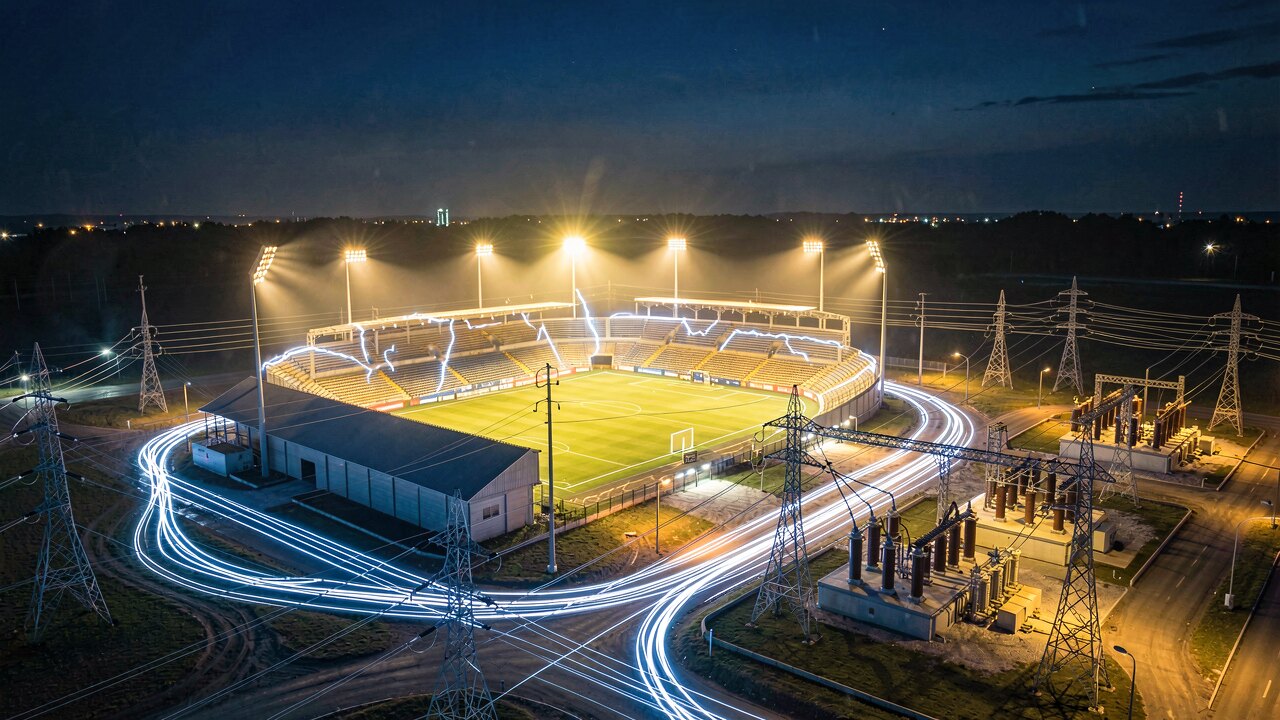
Why This Matters to Us
A stadium is, in miniature, exactly what we deal with at Stromfee every day: a large consumer that is increasingly also a generator (solar) and prospectively a storage unit (battery). Whoever plays all three roles simultaneously wins where electricity prices fluctuate most: charge and self-generate during the day, discharge into the expensive evening peak.
The same logic applies to every PV installation, every CHP unit and every home storage system in Germany — just calculated with real market data rather than estimates. Our freely accessible tools show for your installation what volatile prices and the Solar Peak Law (§51 EEG) mean concretely — and what a storage system would make of it.
Transparency & Sources: Stadium list and capacities from FIFA/StadiumDB/PBS (as of June 2026). Consumption figures from industry surveys of US professional stadiums (electricchoice.com, SEIA, EnergySage). Solar figures for the cited arenas from operator and manufacturer statements. Dortmund world record: RWE press release, November 2025. Consumption values are orders of magnitude and vary considerably depending on climate, roof type and event density — no matchday measurement of individual World Cup matches. The images shown are AI illustrations (FLUX·2), not photographs of specific stadiums.
Have your installation assessed?
Independent grid & drive analysis, direct marketing and metering concept — by HR Energiemanagement.
Get in touch →