SoFi Stadium Los Angeles — Architecture, Power and Sustainability at the 2026 World Cup
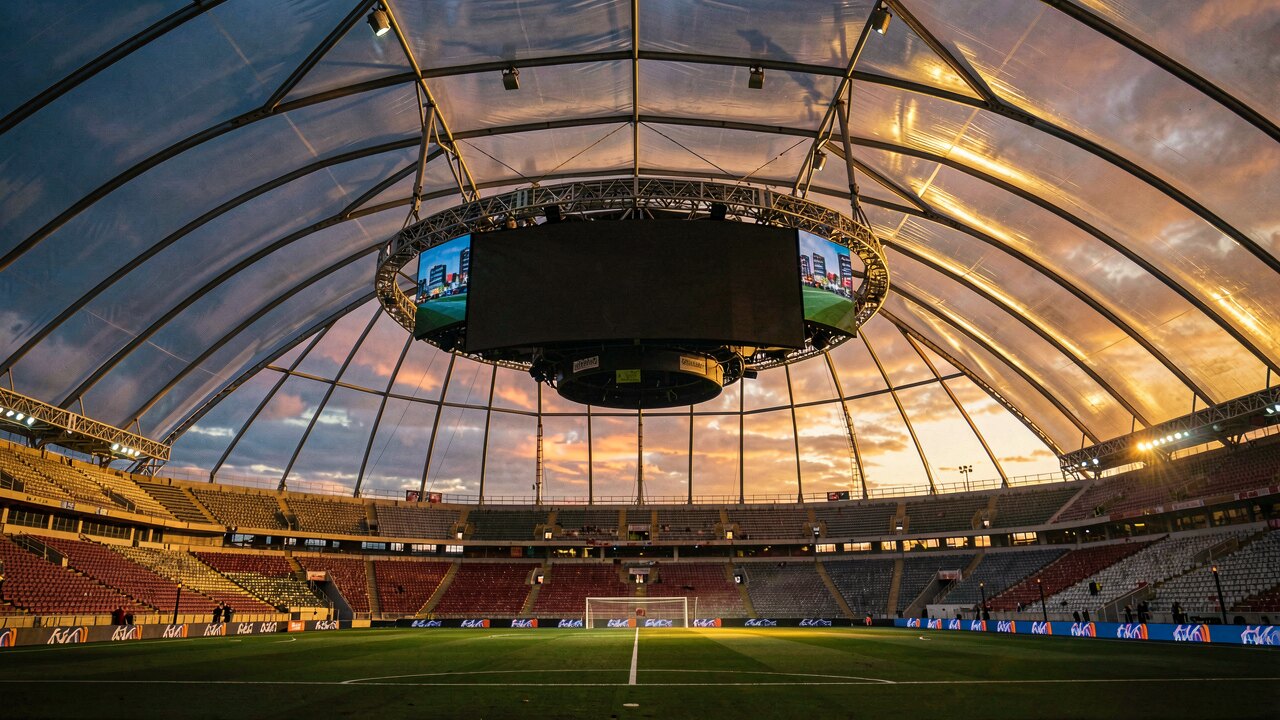
At the FIFA Football World Cup 2026, SoFi Stadium in Inglewood, California, carries the official FIFA name "Los Angeles Stadium" for the duration of the tournament. The arena hosts eight World Cup matches, including two fixtures of the United States national team and a quarterfinal. From an energy standpoint, the stadium is an interesting edge case: virtually no on-site power generation on the roof — instead, a consistent certificate-based approach.
Architecture & Capacity
SoFi Stadium opened on September 8, 2020, and cost approximately $5.5 billion according to available figures — making it the most expensive stadium ever built. It serves as the home ground of two NFL franchises, the Los Angeles Rams and the Los Angeles Chargers, and holds around 70,240 seats in its standard configuration; for special events an expansion to more than 100,000 spectators is possible. For the 2026 World Cup the capacity is adjusted to approximately 69,650 because rows in the corner sections yield to the FIFA standard pitch.
The most striking feature is the translucent ETFE roof: approximately one million square feet in area, consisting of 302 ETFE panels that cover the entire playing field — while the stadium remains open at the sides. ETFE (ethylene tetrafluoroethylene) is a lightweight, light-transmitting fluoropolymer membrane that allows natural daylight into the bowl while offering protection against rain and direct sunlight. A side effect for the energy balance: unlike a heavy, dark roof, ETFE provides almost no suitable surface for rooftop photovoltaics.
What the Stadium Consumes in Electricity
Reliable, publicly available measurements of SoFi Stadium's matchday consumption are not on record. As a reference point: US industry surveys for comparable large stadiums indicate typical values in the range of 50,000 to 65,000 kWh per matchday and annual consumption of 7 to 15 million kWh; peak load during a full evening match is typically 3 to 10 megawatts across the industry. Due to its size and technical specifications, SoFi Stadium likely sits at the upper end of these ranges.
Particularly noteworthy is the "Infinity Screen by Samsung" — the double-sided, oval-shaped video oculus suspended above the centre of the field. It spans approximately 70,000 square feet (about 6,500 m²) of LED surface, is roughly 360 feet long and weighs approximately 2.2 million pounds (about 1,000 tonnes) according to manufacturer data. With 80 million pixels in 4K HDR and more than 260 integrated speakers, it was the largest video board in professional sports worldwide at the time of its 2020 opening. Display loads of this magnitude can amount to several hundred kilowatts on their own — even though exact operating figures are not publicly available.
Add to this the usual major consumers: the LED floodlighting for the pitch and stands, food & beverage operations with cold stores and catering kitchens, and HVAC — relevant especially at evening events in summer given Inglewood's mild but occasionally hot climate. The stadium also features 27,000 LED pucks embedded in the ETFE roof that produce outward-facing graphics and consume electricity as well.
Renewable Energy & Sustainability
SoFi Stadium generates no meaningful share of its own electricity — the ETFE roof does not accommodate conventional rooftop photovoltaics. Instead, the operators (the LA Rams and LA Chargers) rely on Renewable Energy Certificates (RECs). According to the operator, more than 93% of total electricity consumption in 2025 was covered by the purchase of approximately 38,000 RECs sourced from a wind farm in Texas.
This is an important distinction: certificates are not electricity from the socket. The power actually flowing into the building comes from the California grid (the CAISO market) — with its own mix of solar, gas, hydro and nuclear. The RECs represent a calculated equivalent amount of wind power fed somewhere into the US grid. This is a recognised instrument and allows the stadium to communicate that it is "100% renewable" on a balance-sheet basis — but it is not the same as an on-site solar plant that directly generates electricity and displaces grid power.
Worth highlighting on the positive side is the broader sustainability concept: the translucent ETFE membrane reduces the need for artificial electric lighting at daytime events. Microclimate analyses and lifecycle assessments of building systems were carried out for the design and air management of the interior. And the LED upgrade throughout the stadium — from floodlighting to the embedded roof pucks — significantly reduces lighting consumption compared with older halogen metal-halide systems.
Stromfee Assessment
SoFi Stadium is representative of a widespread situation: a technically highly sophisticated large-scale consumer that neutralises its energy appetite on a balance-sheet basis via certificates because on-site generation is structurally not possible. That is not a failure — it is a legitimate, industry-standard approach. The honest conclusion, however, is: the certificate does not replace the kilowatt-hour generated in Inglewood. For facilities where rooftop PV is feasible — industrial buildings, commercial premises, agriculture — direct self-consumption remains the economically stronger lever.
The same question — certificate or own generation, and what does a storage system add — arises with every PV plant in Germany. Our tools calculate this for your installation: negative-price hours, §51 EEG damage and battery storage revenue potential based on real exchange prices.
Transparency & Sources: Capacity and opening year per SoFi Stadium / StadiumDB (as of June 2026). Construction costs per multiple consistent media reports (incl. Wikipedia, InglewoodTickets.com). ETFE roof data: Henderson Engineers / ALSD (302 panels, 1 million sq ft). Infinity Screen: Samsung/Rams press release and Commercial Integrator (70,000 sq ft, 2.2 million lbs, 80 million pixels). REC data: AccuWeather / operator (93%, 38,000 RECs, 2025). World Cup schedule: SoFi Stadium / FIFA (8 matches incl. quarterfinal, FIFA name "Los Angeles Stadium"). Consumption figures from US professional stadium industry surveys (order-of-magnitude ranges, not measured SoFi matchday values). The image is an AI illustration (FLUX·2), not a photograph of the real stadium.
Get your plant assessed?
Independent grid & drive analysis, direct marketing and metering concept — by HR Energiemanagement.
Get in touch →