BC Place Vancouver: The Cable-Net Roof of the 2026 World Cup
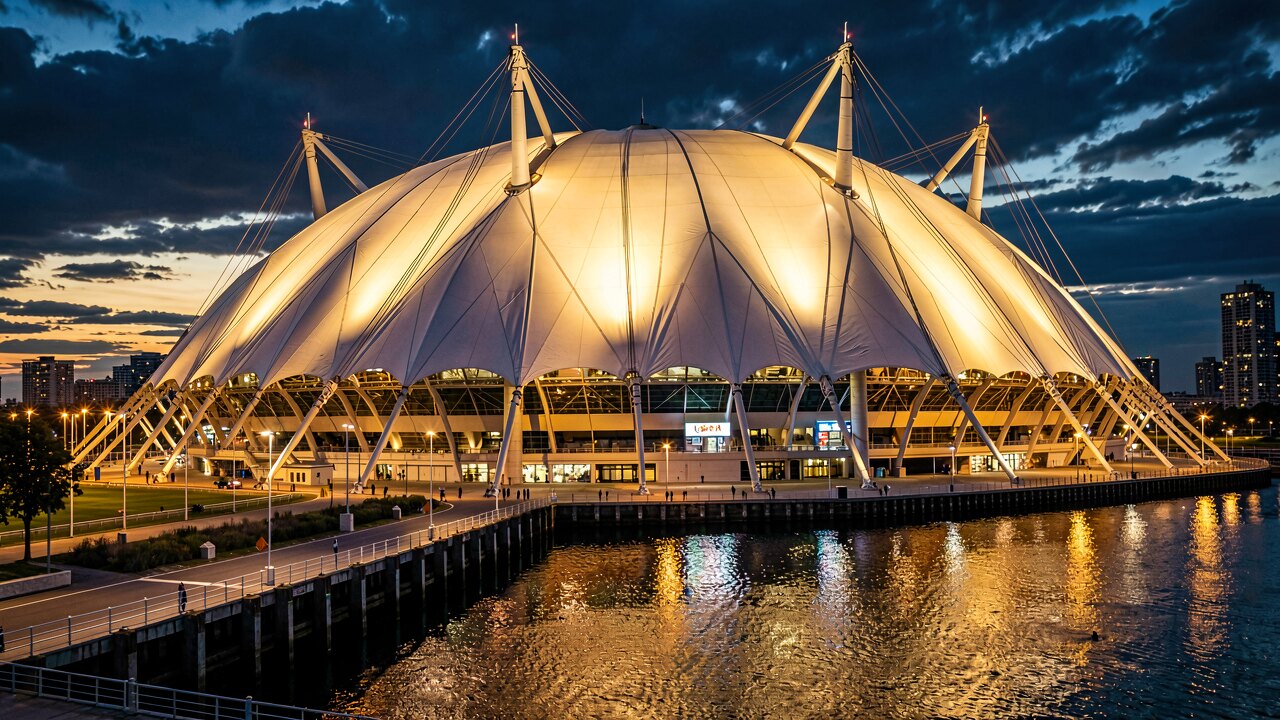
Vancouver, British Columbia, is one of three Canadian World Cup host cities in 2026 — and it brings a structural feature that no other of the 16 World Cup stadiums can match: the world's largest retractable cable-supported membrane roof. Seven matches will be held at BC Place, including a Round of 16 game. Viewed from an energy perspective, the arena combines complex roof engineering, a playing field that was fully converted to natural grass, and a power grid that draws roughly 95 percent of its electricity from hydropower.
Architecture & Capacity
BC Place opened on June 19, 1983 — one of the early major stadiums in North America with a fully covered interior. The original pneumatically supported Teflon membrane was replaced in a comprehensive renovation: in autumn 2011 the arena commissioned its new roof — a retractable cable-net membrane roof that remains the largest of its kind in the world.
The roof spans 36 masts, each roughly 14 stories tall. The membrane surface consists of individual inflatable double-layer TENARA cushions and weighs approximately 135 tonnes. It can be opened or closed in approximately 20 minutes; the structure is engineered to handle a snow load of several million kilograms. Total cost of the renovation: approximately CAD 458 million.
Regular seating capacity is approximately 54,500; for the World Cup it was adjusted to around 48,800 seats (FIFA configuration). Home teams are the BC Lions (Canadian Football League, CFL) and Vancouver Whitecaps FC (Major League Soccer, MLS). During the 2026 World Cup the stadium carries the official FIFA tournament name "Vancouver Stadium".
How Much Power the Stadium Consumes
Operator BC Pavilion Corporation (PavCo) has not published a complete annual electricity figure for BC Place. North American industry surveys for covered multi-purpose stadiums of this size cite typical annual consumption of around 7 to 15 million kWh; on a match day (approximately 10 operating hours) figures in the range of 50,000 to 65,000 kWh are reported. These ranges are industry benchmarks, not measured values for this specific stadium.
The main consumers during operation:
- Lighting (LED): BC Place was converted to LED floodlighting as part of its renovations — one of the most effective single measures to reduce match-day consumption. Vancouver sits at around 49° North latitude; evening and winter matches require full floodlight output.
- Roof drive: Opening and closing the cable-net membrane is an energy pulse: the 135-tonne structure is moved by motors. This event is brief and secondary in the annual picture, but measurably visible in metering data.
- Climate control & ventilation: Vancouver has a temperate oceanic climate. The primary challenge is not cooling but humidity control and ventilation under a closed membrane roof — especially during sold-out matches with approximately 49,000 people inside.
- Grow lights for natural grass: For the 2026 World Cup the usual artificial turf was replaced by real hybrid grass — approximately 95% natural grass with 5% synthetic reinforcement, grown in the Fraser Valley region and installed as sod. Under a closed roof, natural grass requires artificial grow lights to thrive. Operating these UV/full-spectrum lighting systems represents a continuous additional consumption compared to artificial turf — the same pattern seen at other covered World Cup stadiums.
- Catering & infrastructure: Commercial kitchens, refrigerated storage and point-of-sale systems for approximately 49,000 spectators.
Overall, the energy profile of a covered indoor-arena-style stadium in Canada is far less dominated by air conditioning than comparable venues in Atlanta or Houston — instead, grow lights and humidity management move to the foreground.
Renewable Energy & Sustainability
BC Place holds a LEED certification — part of an initiative in which 13 of the 16 World Cup 2026 stadiums were assessed under the LEED standard of the US Green Building Council. PavCo has not published specific details about certification level or output figures for on-site generation; the stadium focuses primarily on efficiency rather than self-generation: LED conversion, building automation and heat recovery.
The decisive context lies in the grid itself: British Columbia draws approximately 95 percent of its electricity from hydropower — mainly through BC Hydro, the province's largest utility. Including small shares from biomass, wind and solar, the renewable share of the BC grid stands at approximately 97–98 percent. The CO₂ intensity of the electricity is approximately 14 g CO₂ eq./kWh according to the Canada Energy Regulator — compared to the German national average of around 380–400 g/kWh, that is a factor of roughly 27. Every kilowatt-hour that BC Place draws from the grid is therefore almost emission-free by default — regardless of whether solar panels are installed on the roof or not.
Structurally this poses a different problem than in US states with a coal- or gas-heavy grid: there, rooftop PV also serves as a decarbonisation argument. In British Columbia the grid is already clean; the lever lies in reducing total consumption, not in substituting a dirty baseload.
Stromfee Assessment
BC Place is a technical special case among the 16 World Cup stadiums: the cable-net membrane roof is more engineering-intensive than any other stadium roof system in the field — and simultaneously defines the energy profile significantly (grow lights for natural grass, roof drive, humidity management). The decision to install real turf for the World Cup is understandable from a sporting perspective, but is no simplification from an energy standpoint.
What sets the stadium apart is not a solar installation on the roof, but the context: electricity from hydropower at 14 g CO₂/kWh is barely achievable in Europe — even with rooftop PV. BC Place shows that the origin of grid electricity is often more important in energy policy terms than the installation on one's own roof. For German plant operators with rooftop PV and grid power from the German energy mix, the opposite applies: here, self-consumption and storage pay off precisely because of the CO₂ intensity of the residual grid.
Our freely accessible tools calculate this for your system using real exchange price data — including the §51 EEG check and storage revenue potential.
Transparency & Sources: Opening date, capacity and roof data from BC Pavilion Corporation (PavCo) / StadiumDB / Wikipedia (as of June 2026). Roof renovation 2011: BC government announcement, CBC News, PavCo statements (CAD 458 million, 36 masts, 135 t, 20 min, TENARA double cushions). World Cup capacity approx. 48,800 and match schedule (7 matches): FIFA / worldcupvancouver.org (as of June 2026). FIFA tournament name "Vancouver Stadium": FIFA.com. Turf conversion (hybrid grass Fraser Valley, UV grow lights, irrigation, vacuum ventilation): BC Place / Hoodline / Yahoo Sports/HITC (May/June 2026). LEED certification BC Place: USGBC / World Cup 2026 certification initiative. BC electricity mix (95% hydropower, approx. 97–98% renewable, 14 g CO₂ eq./kWh): BC Hydro / Canada Energy Regulator 2023. Annual consumption and match-day load: industry benchmarks from electricchoice.com / SEIA for North American major stadiums; no measured match-day values for this arena. Image shown is an AI illustration (FLUX·2), not a photograph of the stadium.
Have Your System Assessed?
Independent grid & drive analysis, direct marketing and metering concept — from HR Energiemanagement.
Get in Touch →Frequently Asked Questions
When was BC Place originally opened?
BC Place in Vancouver was originally opened in 1983.
What major renovation did BC Place undergo?
BC Place underwent a comprehensive renovation in 2011.
What makes BC Place unique among the 2026 World Cup arenas?
BC Place is the only 2026 World Cup arena with the world's largest retractable cable-net membrane roof.
What does the page discuss regarding energy and sustainability at BC Place?
The page provides an overview of BC Place’s energy profile, LEED certification, and Canada’s clean electricity grid.