Mercedes-Benz Stadium Atlanta: Solar Power Champion of the 2026 World Cup
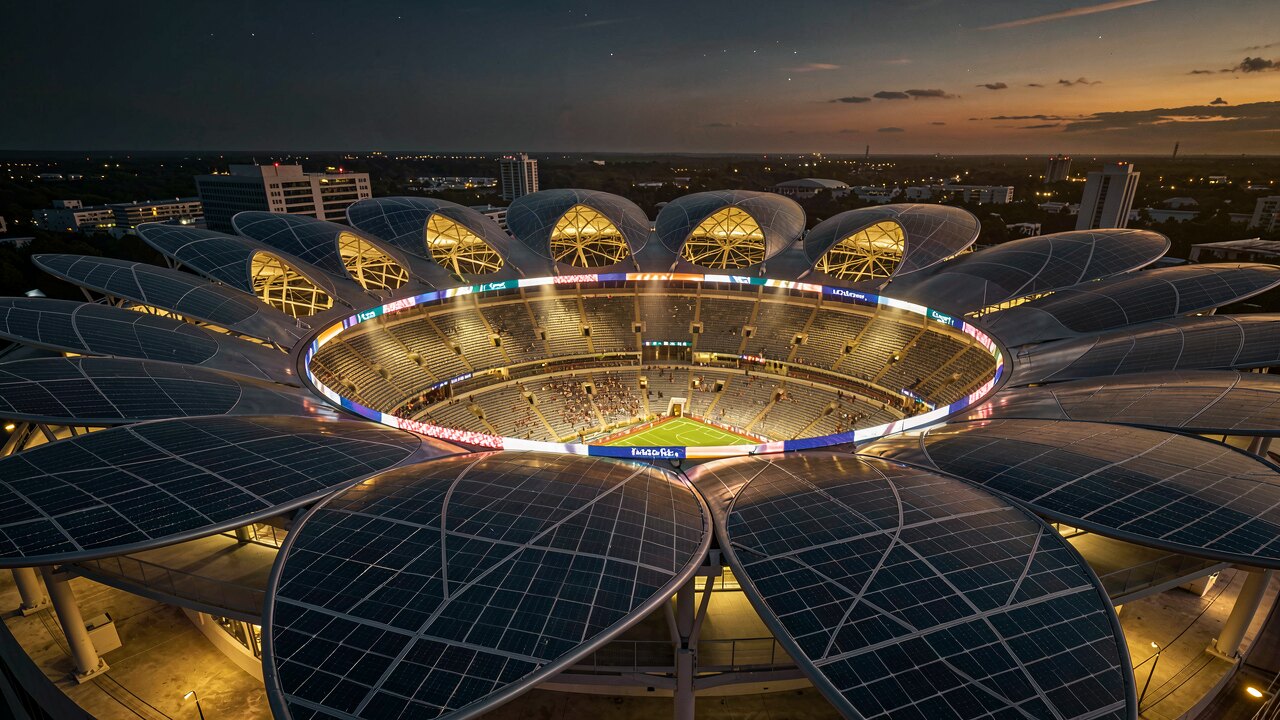
Atlanta, Georgia, is more than a 2026 World Cup host city: Mercedes-Benz Stadium is arguably the most sustainable professional stadium in the USA — the first to achieve LEED Platinum certification. Eight World Cup matches will be held here, including a semifinal on July 15, 2026. Anyone who looks at the arena only as a football stadium misses the truly compelling story: a solar installation that generates more electricity than nine NFL home games consume, a 360° video board the size of a city block, and a retractable petal roof that completely transforms the air-conditioning logic.
Architecture & Capacity
The stadium opened in 2017 and seats approximately 71,000 spectators; for major events such as the Super Bowl or World Cup it can be expanded to approximately 75,000 seats. It was designed by the architectural firm HOK. Its unmistakable feature is the retractable oculus roof: eight triangular ETFE "petals" slide on 16 rails and open the arena in under ten minutes — a mechanism reminiscent of a camera lens. Around the roof opening hangs the Halo video board: approximately 1,075 feet (around 328 m) in circumference, 58 feet (approximately 18 m) high, around 63,000 square feet (approximately 5,900 m²) of display area with nearly 25 million pixels. It is the largest contiguous 360° video board in the world.
The home teams are the Atlanta Falcons (NFL) and Atlanta United (MLS). During the 2026 World Cup, the stadium carries the FIFA tournament name "Atlanta Stadium".
How Much Power the Stadium Uses
Exact annual consumption figures for Mercedes-Benz Stadium have not been fully published by the operator AMB Sports & Entertainment. Industry surveys for large US professional stadiums of this class typically cite 7 to 15 million kWh per year; the stadium reportedly uses approximately 29 percent less than its comparison baseline thanks to LEED measures. On a matchday (approximately 10 operating hours), comparable arenas see figures on the order of 50,000 to 65,000 kWh — a rough industry framework, not a measured matchday figure for this stadium.
The largest consumers in operation:
- Air conditioning (HVAC): Atlanta lies in a humid subtropical climate zone. On a July afternoon — such as the World Cup Semifinal — cooling can become the dominant load, particularly when the petal roof is closed. For enclosed southern arenas of this size, matchday cooling loads on the order of 15 MWh are cited (industry figure, not a measurement for this arena).
- Halo video board: The 360° LED display with approximately 25 million pixels and nearly 5,900 m² of area draws power continuously during operation. Manufacturers of LED boards of this class cite typical area power densities of 0.5 to 1.5 kW/m² — at approximately 5,900 m² this gives a rough range of approximately 3 to 9 MW for the board alone at full load. A verified manufacturer figure for the Halo Board is not available to us.
- Floodlights: The stadium relies entirely on LED floodlights, which require significantly less power than older halogen metal halide systems and switch instantly — a direct result of LEED requirements.
- Catering & infrastructure: Large kitchens, cold storage and point-of-sale infrastructure for approximately 71,000 people.
The retractable roof itself consumes drive energy during opening and closing, but this occurs as a brief pulse and plays a minor role in annual consumption.
Renewable Energy & Sustainability
Mercedes-Benz Stadium is the solar showpiece among the 2026 World Cup arenas — and for good reason:
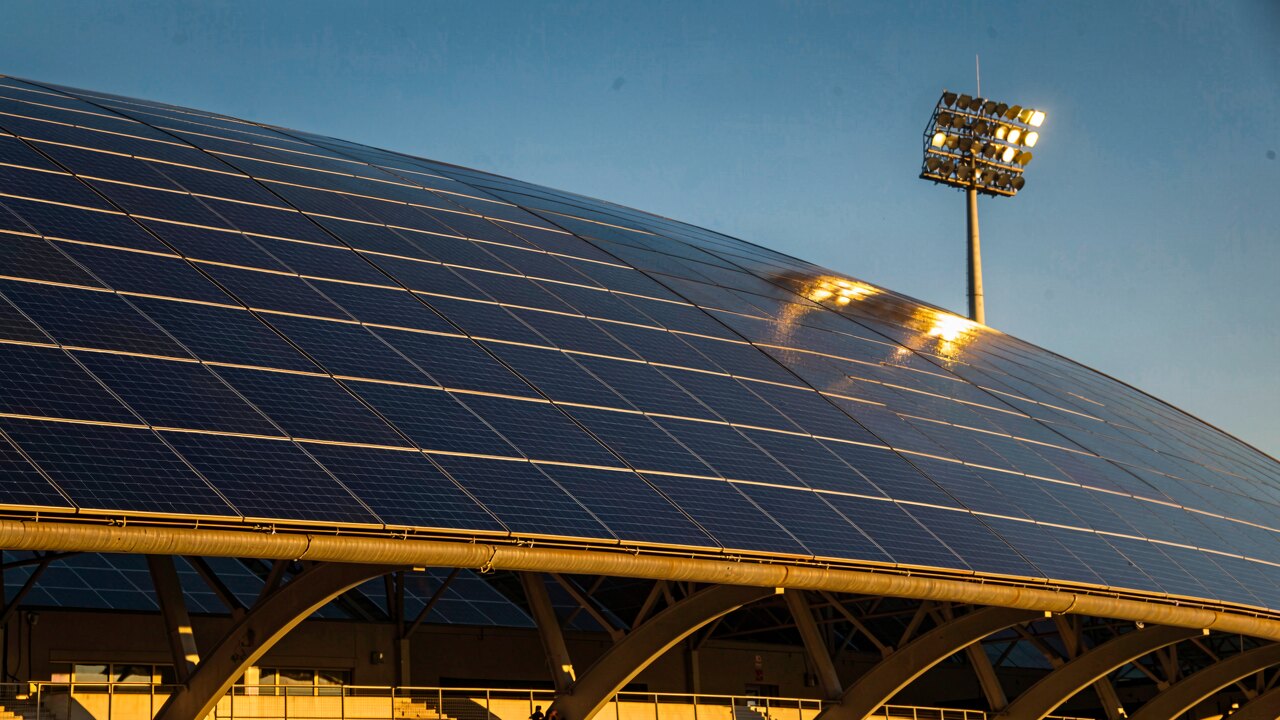
- Approximately 4,000 solar modules from Georgia Power were installed on the roof and ancillary buildings of the arena. According to operator figures, the installation generates over 1,600 MWh per year — calculated to be more than nine complete Atlanta Falcons home games.
- Water consumption has been reduced by 47 percent versus the comparison baseline — through rainwater harvesting systems that supply service water for flushing and irrigation.
- Total electricity consumption is approximately 29 percent below the LEED baseline per the operator — achieved through LED lighting, high-efficiency chillers and active building energy management.
- LEED Platinum: The US Green Building Council certification at the highest level was awarded in 2017 — as the first professional stadium in the USA at this level. LEED assesses energy, water, materials and indoor air quality.
- EV charging infrastructure is available on the premises.
Assessment: The 1,600+ MWh solar output per year is a serious contribution — and at the same time a fraction of the annual total consumption of an arena of this size. Solar covers here an estimated 10 to 20 percent of annual demand (rough range based on industry annual figures; no published coverage ratio from the operator). That is not sufficient for energy self-sufficiency, but is above average compared with comparable US arenas — and leading among the 16 World Cup 2026 stadiums.
2026 World Cup Role: Atlanta as Semifinal Venue
Atlanta hosts eight matches of the 2026 World Cup: five group-stage games (including Spain twice), a round of 16, a quarterfinal and — as the highlight — the Semifinal on July 15, 2026. This makes Mercedes-Benz Stadium one of the four venues hosting the tournament's most important matches. The FIFA tournament name is "Atlanta Stadium".
Stromfee Assessment
Mercedes-Benz Stadium demonstrates what is technically possible today: LEED Platinum, solar, rainwater harvesting, full LED — all integrated in a single structure that simultaneously operates one of the world's largest LED video systems and a motor-driven retractable petal roof. The 4,000 modules and 1,600+ MWh annual output are not greenwashing, but a verified installation with Georgia Power as partner. The consumption side — HVAC in Atlanta's summer heat, the Halo Board, catering for 71,000 people — nonetheless remains a serious load on the medium-voltage grid.
The same question that stadium operators ask themselves — How much of my own demand can I cover with solar, and what would a storage system make of it? — is also asked by companies with roof space and peak loads. Our tools calculate that for your installation with real exchange price data.
Transparency & Sources: Capacity and opening date from operator AMB Sports & Entertainment / StadiumDB (as of June 2026). Solar data (4,000 modules, >1,600 MWh/year, LEED Platinum, −29% electricity, −47% water): operator figures from mercedesbenzstadium.com and Georgia Power. Halo Board dimensions: operator figures / Ross Video Case Study. Annual consumption and matchday load: industry framework from electricchoice.com / SEIA; no measured matchday figures for this arena. LED power density: manufacturer figure range, not verified for the Halo Board. World Cup schedule: FIFA / mercedesbenzstadium.com (as of June 2026). Images shown are AI illustrations (FLUX·2), not photographs of the stadium.
Have your installation assessed?
Independent grid & drive analysis, direct marketing and metering concept — by HR Energiemanagement.
Get in touch →