What sonstige Direktvermarktung means
Sonstige Direktvermarktung refers to selling electricity by a generator or other market participant directly on the power exchange, outside the regular standardized contract trading. In contrast to the regular exchange trade, where power is traded via standardized contracts, sonstige Direktvermarktung takes place outside the organized trading platforms.
For a battery, this is the framework under which stored energy is marketed. Instead of a fixed feed-in tariff, the operator, or a direct marketer acting on their behalf, places the battery's charge and discharge into the markets where the price signal justifies it.
A battery is on only one market per time slice
The central constraint of storage marketing is that a battery, per time slice, can be active on only one market. Its power and its state of charge are a single physical resource, so energy sold on the day-ahead market cannot simultaneously be held as balancing reserve.
Stromfee frames the direct-marketer view as 14 markets seen from a direct marketer's angle, grouped into energy arbitrage, balancing reserve, and strategy and context. The task of Direktvermarktung is therefore not choosing one market, but scheduling: deciding which market each slice of the day is committed to.
The markets: arbitrage and balancing reserve
Energy arbitrage covers buying low and discharging high, primarily on the day-ahead and intraday markets. Balancing reserve covers reserving capacity that the grid can call, such as FCR, aFRR, and mFRR, in both the positive and negative direction.
The markets are not equally profitable. In Stromfee's direct-marketer breakdown, some balancing products are frequently the laggard where reservation rarely pays, while others complement each other, for example negative mFRR complementing negative aFRR in negative reservation. Figures shown for individual products, such as RR positive at 15,149 EUR/MW and mFRR negative at 20,512 EUR/MW, illustrate that the ranking of markets shifts and has to be re-evaluated rather than assumed.
Allocation: planning the spread across markets
Because a battery can serve only one market at a time, Direktvermarktung is an allocation problem. Stromfee calls its allocation signal Automix, a signal across the markets that indicates where the money lies today, so that each time slice is assigned to the market with the best expected return.
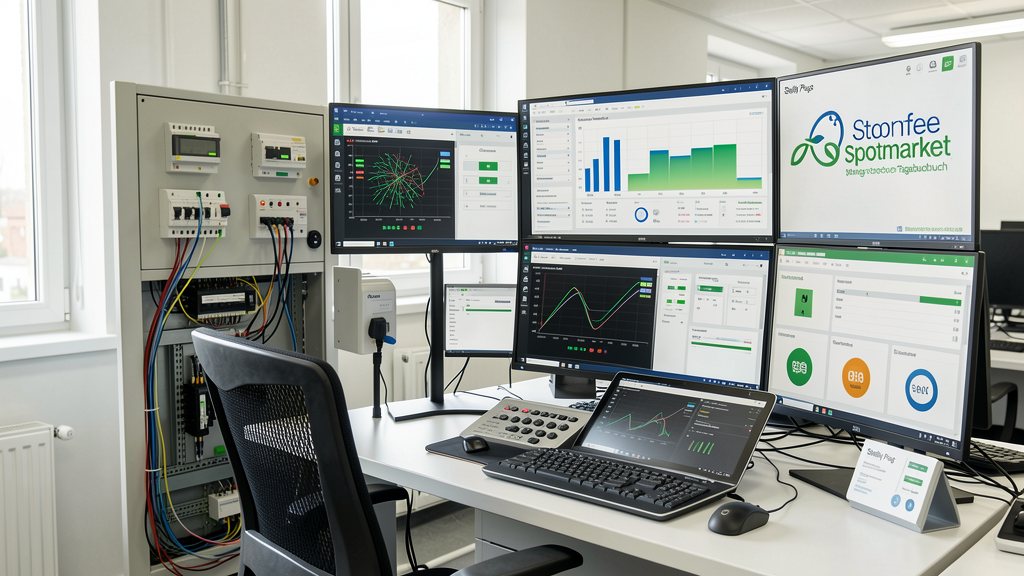
The Stromfee BESS Inside view for direct marketers presents this as the menu of available markets plus the schedule that connects them: a signal source that shows where the revenue currently sits, and a plan that binds the physical battery to it.
Verifying the plan against the asset and the market
Optimization is only useful if it can be checked against what the battery actually did and against what was theoretically achievable. Stromfee's BESS.optimizer reads a storage system directly via Modbus TCP and optimizes, verifies, and monitors it, manufacturer-independent and marketer-independent.
On the optimizer, day-ahead, intraday, FCR, and aFRR are treated as four markets that are cross-optimized together rather than in isolation. Performance is expressed as a Percent of Perfect Foresight (PoP) benchmark, the share of the theoretically perfect, hindsight-optimal revenue that the real schedule captured, for example on a reference 10 MW / 20 MWh system. Stromfee also computes the revenue maximum of a battery of at least 1 MW from public data, and compares it against what actually arrives.
Where Stromfee fits in Direktvermarktung
Stromfee positions itself as an independent service layer between the hardware manufacturer, the direct marketer, and the operator. It reads the BESS, plans the allocation across markets, and then verifies whether the realized revenue matches the plan.
The practical value for an operator under Direktvermarktung is twofold: knowing the revenue maximum the asset could reach, and checking billing and settlement against it, finding the gap between the modeled optimum and what the direct marketer actually delivered.
FAQ
What is the difference between Direktvermarktung and a fixed feed-in tariff for storage?
Under a fixed tariff, energy is remunerated at a set rate. Under Direktvermarktung, the battery's energy and capacity are sold on the power exchange and balancing markets, so revenue depends on price spreads and reservation prices rather than a fixed rate.
Can a battery earn on several markets at the same time?
No. Per time slice a battery is on only one market, because its power and state of charge are a single resource. Serving day-ahead energy and holding balancing reserve at the same instant is not possible, which is why allocation across markets over the day is the core planning task.
How is a battery's Direktvermarktung performance measured?
Stromfee uses a Percent of Perfect Foresight (PoP) benchmark: the realized revenue compared against the theoretical maximum a perfectly informed schedule would have earned. It computes that revenue maximum for batteries of at least 1 MW from public data and compares it to what actually arrived.
Which markets does Stromfee's optimizer cross-optimize?
The BESS.optimizer cross-optimizes day-ahead, intraday, FCR, and aFRR together, reading the storage system directly via Modbus TCP and doing so independently of the hardware manufacturer and the direct marketer.