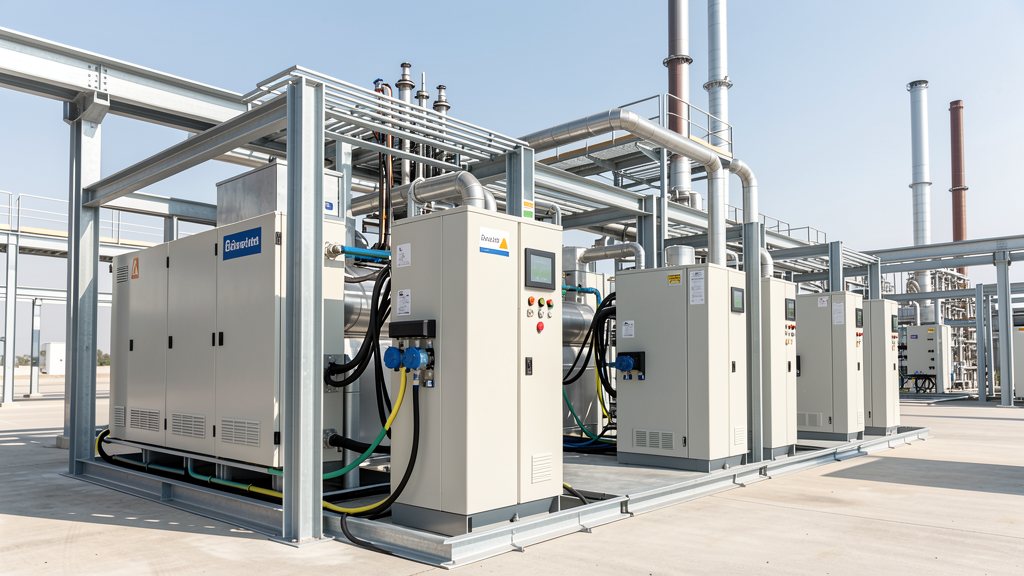
What the FCR market is
FCR (Frequency Containment Reserve, R1 in Belgium's Elia nomenclature) is the primary reserve that stabilises grid frequency second by second. When frequency drifts from its setpoint, providers respond automatically and proportionally — no manual dispatch and no scheduled call. Because the response must be near-instant, fast-responding batteries are well suited to the product.
FCR is a symmetric product: the asset must be able to both inject and absorb power. Stromfee's BESS Academy describes it as pure reservation with a derating of roughly 0.83 to keep enough state-of-charge headroom for SoC management, so a battery cannot bid its full nameplate power into FCR.
How FCR revenue works
The defining feature of the FCR market is that revenue comes from reserving power, not from trading energy. The battery earns for availability — for standing ready to respond — rather than from the spread between buying and selling electricity. In Austria this makes FCR a comparatively stable, predictable revenue stream through APG's balancing markets, in contrast to the volatility of wholesale arbitrage.
As an illustration of order of magnitude, Stromfee's BESS Academy lists an FCR revenue-potential figure of €14,332/MW for May 2026. Because reserve demand grows as the renewable share rises, balancing is described as a structurally expanding revenue stream alongside day-ahead trading.
FCR within the reserve stack
FCR is the first of several sequential reserve products. After FCR (primary), aFRR (automatic Frequency Restoration Reserve, R2) restores frequency to setpoint; in Belgium aFRR is Elia's main day-to-day balancing product, with roughly 140 MW typically needed. mFRR (manual Frequency Restoration Reserve, R3) follows for slower, dispatched balancing.
aFRR pays a two-part remuneration: a capacity price for reserved availability plus an energy price for electricity actually delivered on call. Batteries can stack these products — FCR, aFRR and mFRR — on top of day-ahead and intraday arbitrage, with an energy management system deciding hour by hour which market pays best. Elia has opened its products to decentralised and aggregated providers, widening access beyond large plants.
FCR markets across Europe
National TSOs run their own FCR designs. Fingrid in Finland operates technology-neutral reserve markets that batteries dominate, split into FCR-N and FCR-D for frequency containment, plus FFR (fast frequency reserve) and aFRR; Fingrid data show BESS already supplied about 57% of FCR-N hourly energy in 2021. In Austria, APG's FCR and aFRR markets provide the balancing income layered on top of wholesale arbitrage.
Hungary illustrates how quickly battery capacity is entering these markets: grid-connected battery capacity rose from 35.3 MW at end-2024 to 73.2 MW by May 2025, with analysts forecasting over 500 MW by end-2026 and a 1 GW policy target for 2030 — capacity that will bid into FCR and the restoration reserves.
European integration: PICASSO and MARI
The FCR-adjacent restoration markets are being coupled across borders through the pan-European balancing platforms PICASSO (for aFRR) and MARI (for mFRR). Belgium's Elia is coupling into both, and the Nordic TSOs join PICASSO in 2026. Hungary's MAVIR is scheduled to join PICASSO and MARI on 30 September 2026.
Cross-border coupling deepens the addressable flexibility pool and balancing liquidity. It can also moderate price spikes, so operators should treat historical reserve prices as a moving target rather than a fixed forecast when sizing a business case.
The Stromfee angle: co-optimising FCR with day-ahead arbitrage
Because FCR pays for reservation while day-ahead arbitrage pays for the spread between buying cheap and selling dear, the two compete for the same battery capacity and state of charge. Deciding which market to serve in any given hour is an optimisation problem, not a fixed allocation.
Stromfee's expertise is in storage arbitrage on the day-ahead market — the baseline revenue layer against which FCR and the restoration reserves are stacked. A battery's economics come from an EMS that decides hour by hour which market pays best, and understanding the day-ahead spread is the foundation for judging when reserving power for FCR is worth more than trading energy.
FAQ
How is FCR revenue different from arbitrage?
FCR pays for reserving power — the battery is paid to stand by and respond automatically to frequency deviations — whereas arbitrage earns from the price spread between buying and selling energy. FCR is symmetric (inject and absorb) and, per Stromfee's BESS Academy, is derated by roughly 0.83 to keep state-of-charge headroom.
How does FCR relate to aFRR and mFRR?
FCR is the fast primary reserve that reacts within seconds. aFRR (secondary) then restores frequency to setpoint and pays a capacity price plus an energy price for delivered electricity; mFRR (tertiary) is slower, dispatched reserve. Batteries can stack all three on top of day-ahead and intraday arbitrage.
What are PICASSO and MARI?
They are the pan-European balancing platforms — PICASSO for aFRR and MARI for mFRR. Belgium's Elia is coupling into both, the Nordic TSOs join PICASSO in 2026, and Hungary's MAVIR is scheduled to join both on 30 September 2026. Coupling deepens balancing liquidity and can moderate price spikes.
Are batteries competitive in the FCR market?
Their fast response suits FCR well, and adoption is visible in the data: Fingrid reports BESS supplied about 57% of FCR-N hourly energy in Finland as early as 2021, and Hungary's grid-connected battery capacity roughly doubled from 35.3 MW at end-2024 to 73.2 MW by May 2025.