What "KI Vision" means in an energy context
The idea of giving an energy plant a "brain" — something that learns, optimizes and predicts — is the core of AI in the energy world. That brain has changed considerably over time, and its development was driven largely by cloud computing, which moved AI from isolated local devices toward a connected, continuously improving system.
For Stromfee this is not an abstraction. AI is applied to two concrete jobs: deciding when a storage unit should charge or discharge, and watching plant operation for anomalies. Both tasks depend on the same underlying capability — turning live data into decisions and predictions instead of leaving it in a monthly report.
Optimizing storage strategy on the day-ahead market
A storage strategy is a schedule of charge and discharge actions. On the day-ahead market, electricity prices vary hour by hour, so the value of storing energy depends on when it is used. AI helps translate those price patterns and a plant's own generation and load profile into a strategy that lowers cost.
The same principle already shows up in Stromfee's consumption tools. The Stromfee-Tagebuch pairs AI with clear visualizations so users can see where energy goes and act on it — the article on the diary describes how this combination raises efficiency and lowers costs. Making consumption and price signals visible is the first step; scheduling storage against day-ahead prices is the extension of that logic to batteries.
Monitoring plants in production
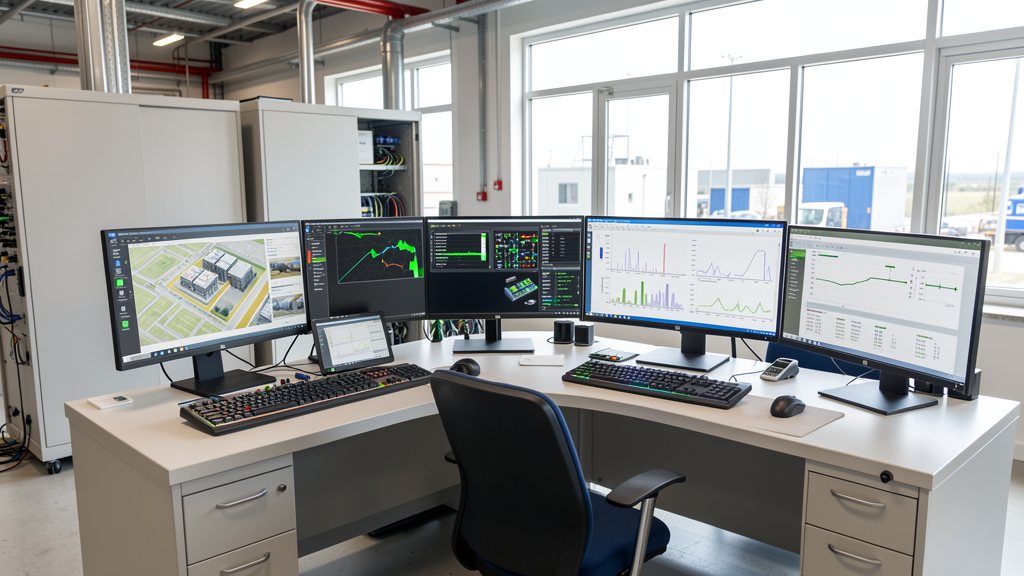
Monitoring is the second half of KI Vision. Stromfee runs a BGA (biogas plant) monitoring pipeline in which AI agents work with plant documentation and live data to keep track of operation.
This pipeline is not a prototype: it has been in production use for about a year. That track record is also what let Stromfee confirm practical findings about how the agents behave — for example, which form of documentation actually helps them work reliably (see the next section).
The knowledge base behind the agents (Karpathy pattern)
In spring 2025 Andrej Karpathy made a simple observation: LLM agents work worse with README files than with linked wikis. After a year of running the BGA monitoring pipeline, Stromfee found the same thing in practice.
Concretely, an Obsidian vault built from clean [[Wikilinks]] gives agents such as Claude, Cursor and GPT noticeably better context than a single monolithic document. For KI Vision this matters because the quality of a monitoring or optimization decision depends on the quality of the context the agent can retrieve — so the documentation format is part of the engineering, not an afterthought.
From local device to cloud — and the infrastructure it needs
The shift Stromfee describes is one from a "local genius" — an AI confined to a single device — to a "global brain" that learns across a connected system via the cloud. That shift is what makes continuous, fleet-wide monitoring and optimization possible in the first place.
It also has a physical cost: cloud AI runs in data centers, and those are being built at large scale. Stromfee has documented projects such as the 204 MW VIRTUS greenfield data center at Wustermark near Berlin (completion 2026–27) and the Anthropic/Fluidstack campus in Texas at roughly 300 MW, tied to a 50 billion US-dollar deal announced in November 2025 and targeting NVIDIA Grace Blackwell hardware. For the energy sector these sites are both customers and a growing load to plan around.
FAQ
Is KI Vision a single product or a set of methods?
It is a set of methods and components working together — AI agents, a wiki-based knowledge base and cloud infrastructure — applied to two jobs: day-ahead storage strategy and plant monitoring. Stromfee describes these as working parts, not a packaged black box.
Why does Stromfee use a wiki instead of README files for its AI agents?
Because linked wikis give LLM agents better context than monolithic README files. This follows Karpathy's spring-2025 observation, which Stromfee confirmed after about a year of running its BGA monitoring pipeline with an Obsidian vault of clean wikilinks.
Is the plant monitoring actually in use or still experimental?
The BGA monitoring pipeline has been in production use for roughly a year. That production experience is also the basis for Stromfee's findings on how to document knowledge for the agents.
What does data center construction have to do with AI in energy?
Cloud AI — the "global brain" that enables continuous optimization and monitoring — runs in data centers. Stromfee tracks large builds such as the 204 MW VIRTUS site at Wustermark and the ~300 MW Anthropic/Fluidstack campus in Texas, because these sites are significant new electrical loads for the energy sector to plan around.