Why AI compute strains grid capacity
AI applications need large amounts of computing power, delivered in specialized data centers. Sites equipped with the newest NVIDIA GPUs place new demands on the German energy infrastructure, because they concentrate load in a way conventional server halls did not. Grid capacity at the connection point, not just the availability of hardware, becomes the limiting factor for where these centers can be built.
The scale is set by the accelerators themselves. xAI's Colossus in Memphis runs 100,000 NVIDIA H100 GPUs, draws about 150 MW of electrical power, and delivers roughly 2.9 ExaFLOPS (FP16) for AI training. A single planned site can therefore rival the demand of a small city, which is why network capacity has to be assessed before any construction decision.
How much power an AI data center draws
Electrical demand ranges from tens to hundreds of megawatts per site. Colossus in Memphis is around 150 MW today. Brookfield's planned AI compute hub in Stockholm is designed for up to 750 MW of IT power, positioned as Scandinavia's largest compute hub, with an investment volume of up to 10 billion dollars and a planned start from 2027 onward (an early-stage industry estimate).
These figures are IT and facility load, not just the GPUs. Every watt fed into computing has to be matched by power for cooling, distribution losses and auxiliary systems, so the grid connection must be sized for the whole facility rather than the chip power alone.
Cooling: from free cooling to liquid cooling
Cooling accounts for a significant share of a data center's total energy consumption, which makes the cooling concept a central cost and efficiency decision rather than an afterthought. Two approaches dominate. Where the climate allows it, free cooling uses cold ambient air. The Stockholm site is planned around a mean annual temperature of about 8 °C, which is ideal for free cooling and saves energy compared with warmer Southern European locations.
Where power density is high or the climate is hot, mechanical and liquid cooling take over. Colossus uses liquid cooling to remove heat from its dense H100 racks. In hot climates such as Dubai, efficient cooling systems for data centers and buildings are business-critical, and the cooling plant becomes the largest lever for reducing operating cost — which is where AI-assisted monitoring of large chillers is applied to keep them running at their best operating point.
Load profiles and real-time monitoring
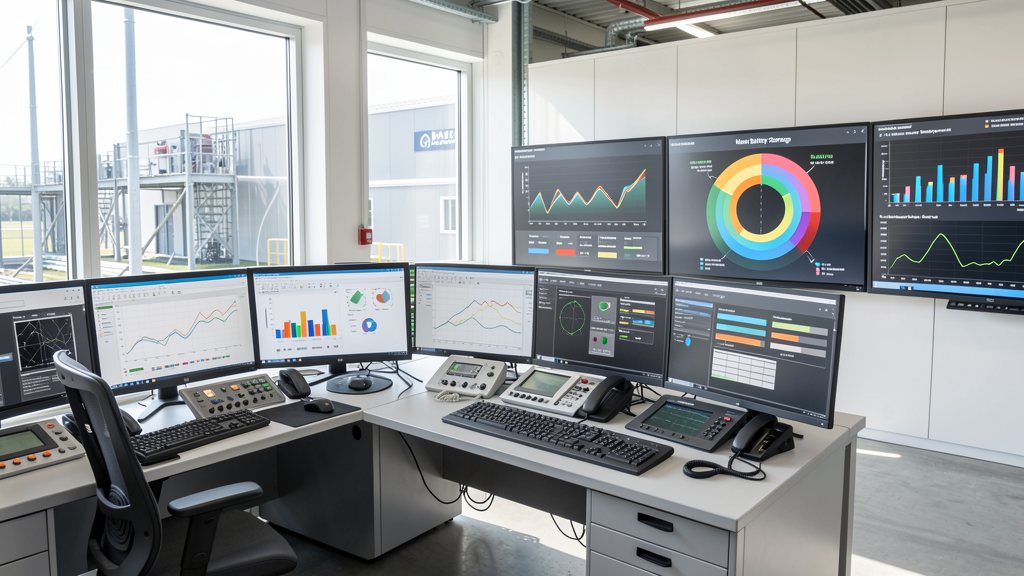
Both the compute load and the cooling load of a data center vary over time, and understanding these load profiles — ideally from live data — is the basis for optimization. Stromfee's analysis of data center load curves worldwide focuses specifically on live measurement, including the load contribution of the cooling system, rather than on nameplate figures.
In practice this means reading PV generation, storage state and consumers in real time and vendor-independently, so that lost revenue and savings potential become visible. For a cooling plant, continuous monitoring makes it possible to detect when a chiller drifts from its efficient operating range and to correct it before the extra energy shows up on the bill.
Battery storage arbitrage and load shifting
Not every task has to run at the moment electricity is most expensive. The same principle Stromfee applies in other energy-intensive operations — using AI to schedule flexible loads into cheaper hours, such as at night or midday — carries over to data-center support systems and their cooling.
Battery storage adds a second lever: energy-storage arbitrage means charging when electricity is cheap and discharging or shifting consumption when it is expensive, lowering the effective energy price without cutting compute. Combined with pre-cooling and smart scheduling of flexible loads, this turns a static, high-cost electricity draw into a managed load that responds to market prices.
How Stromfee supports AI data center operators
Stromfee provides specialized solutions for the power supply and cooling of AI data centers, built on the same real-time metering approach used across its energy projects: PV, storage and consumers are read live and vendor-independently to make cost drivers and savings visible.
The building blocks are continuous load-profile monitoring, AI-assisted optimization of large cooling units, and battery-storage arbitrage to reduce energy cost. A free initial analysis establishes where a specific site loses money on cooling energy or misses arbitrage potential before any hardware decision is made.
FAQ
How much electricity does an AI data center use?
It depends on scale. xAI's Colossus in Memphis draws about 150 MW with 100,000 NVIDIA H100 GPUs, while Brookfield's planned Stockholm hub is designed for up to 750 MW of IT power. Demand for AI sites is typically measured in tens to hundreds of megawatts.
Why is cooling such a large part of the energy bill?
Cooling accounts for a significant share of a data center's total consumption, and that share grows with GPU power density and warm ambient conditions. In hot climates like Dubai, efficient cooling is business-critical, which is why AI-assisted monitoring of large chillers is used to keep them at their efficient operating point.
What is the difference between free cooling and liquid cooling?
Free cooling uses cold outside air and works best in cool climates — the Stockholm site at roughly 8 °C mean annual temperature is planned around it. Liquid cooling circulates coolant directly to remove heat from dense racks and is used where power density is high, as in Colossus.
How does battery storage arbitrage help a data center?
Arbitrage means charging the battery when electricity is cheap and discharging or shifting consumption when it is expensive, lowering the effective energy price without reducing compute. Combined with AI scheduling of flexible loads and pre-cooling into cheaper hours, it turns a fixed high-cost draw into a price-responsive load.