350 MW in Atlanta: Microsoft Fairwater Goes Live as the Company's Most Powerful AI Site
Microsoft Fairwater Atlanta — Atlanta, GA, USA
- Over 350 MW operational since October 2025 (Terakraft report)
- 150,000+ NVIDIA GB200 Blackwell GPUs
- Closed-loop liquid cooling — no air cooling at all
- Azure Maia 100 AI accelerators + Cobalt 100 CPUs alongside Nvidia hardware
- Part of Microsoft's 2 GW multi-site Fairwater program
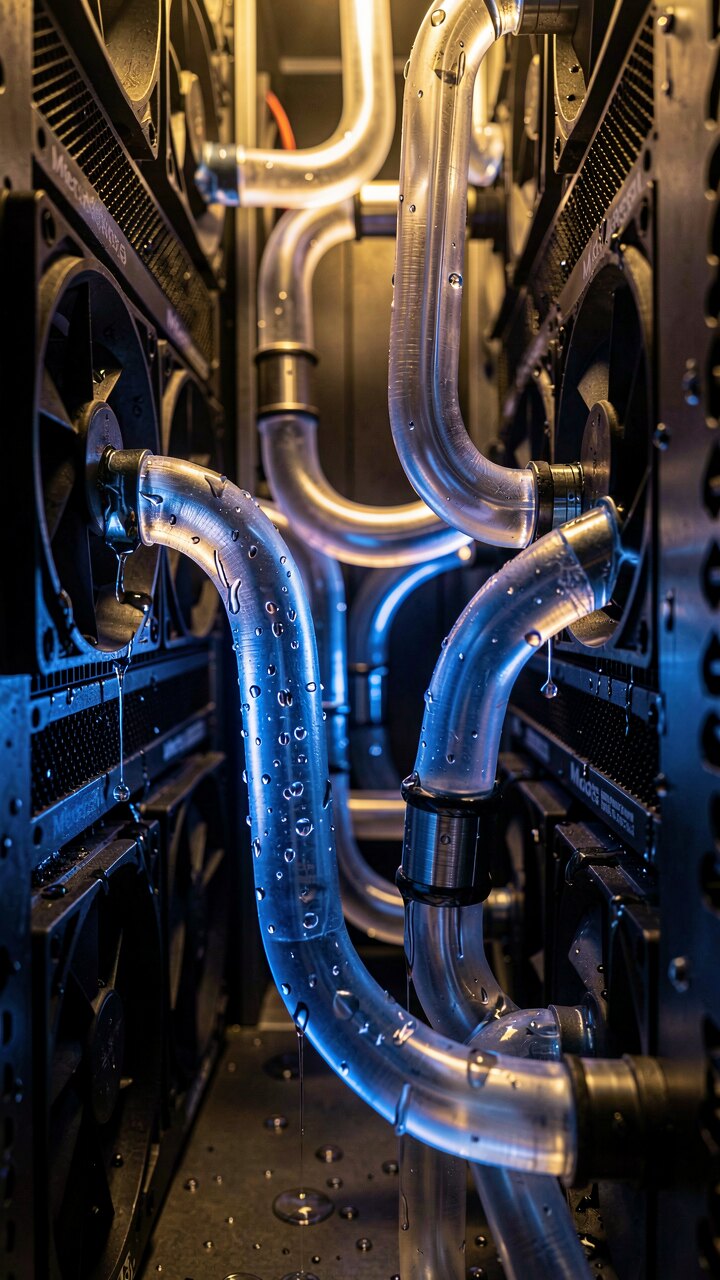
When Liquid Cooling Becomes the Only Option
In October 2025, Microsoft switched on a datacenter campus in Atlanta that its own engineers described — without hyperbole — as "the most powerful Microsoft site in the world." The numbers behind that claim start with a fundamental physics problem: the NVIDIA GB200 Blackwell GPU draws approximately 1,000 watts per chip under AI training load. Multiply by 150,000 chips and you have 150 megawatts of heat produced by GPUs alone, before touching power consumed by networking, storage, custom silicon, or facility systems. No air-cooling architecture on Earth can remove that heat density from a server floor of any financially rational size. Liquid cooling is not a preference at Fairwater Atlanta — it is the only engineering path that makes the campus possible.
The facility uses a closed-loop liquid cooling system running throughout every server hall. "Closed-loop" is the key distinction: unlike open-circuit evaporative cooling towers that consume thousands of gallons of water per hour, a closed-loop system recirculates the same coolant continuously, transferring heat to dry coolers or heat exchangers without evaporating the working fluid. In regions facing water stress — and Atlanta's metropolitan watershed has faced drought conditions multiple times in the past decade — this is a significant operational and regulatory advantage. It is also a capital efficiency choice: closed-loop systems are more expensive to build but cheaper to operate, and at 350 MW they save enough operating cost to justify the premium many times over.
Why Atlanta?
Site selection for a facility of this scale is never accidental. Atlanta offers a specific combination of infrastructure assets that made it competitive for the Fairwater flagship. The city is one of the largest internet exchange points in the southeastern United States — multiple major fiber routes converge here, giving the campus high-bandwidth, low-latency access to Microsoft's existing Azure backbone. The Southeastern US power grid provides access to diverse generation capacity. Georgia Tech and surrounding research institutions supply a talent pipeline for the engineers who operate and expand the facility. And Atlanta's existing commercial real estate and construction infrastructure could accommodate a project of this footprint without the multi-year permitting delays that have slowed datacenter development in constrained markets like Northern Virginia.
According to the Terakraft industry report published in October 2025, the Atlanta site exceeded 350 MW at launch. This figure reflects operational power at activation — not the campus's final build-out capacity. Industry estimates, not confirmed by Microsoft, suggest the eventual campus ceiling could be considerably higher as additional server halls come online.

Three Silicon Architectures Under One Roof
What makes Fairwater Atlanta unusual even by hyperscale standards is the depth of custom silicon running alongside the Nvidia hardware. Three distinct compute architectures operate in parallel:
- NVIDIA GB200 Blackwell GPUs — 150,000+ units. The GB200 delivers roughly 2.5× the AI training throughput of the H100 generation at similar power draw. At 150,000 units, this is one of the single largest Blackwell deployments anywhere.
- Azure Maia 100 — Microsoft's own AI accelerator, designed in-house. Maia 100 is optimized for inference on Microsoft's model families — Phi, GPT-4 variants, Copilot workloads — allowing Microsoft to bypass Nvidia licensing costs on inference and optimize cost-per-token for its specific architectures.
- Azure Cobalt 100 — Microsoft's ARM-based CPU for cloud-native workloads. In an AI datacenter context, Cobalt 100 handles orchestration, preprocessing, and non-GPU tasks, reserving the expensive accelerator resources for pure AI compute.
This three-silicon strategy — buying the best available third-party GPU while simultaneously deploying proprietary accelerators — is increasingly the pattern at the frontier of AI infrastructure. It reduces supplier concentration risk and captures margin that would otherwise flow to Nvidia on inference workloads where proprietary silicon is competitive.
Part of the 2 GW Fairwater Program
Atlanta is not a standalone project. It is the first live campus in Microsoft's Fairwater initiative — a multi-site program that industry analysts describe as targeting more than 2 GW of dedicated AI compute across a network of identical-twin facilities. The "identical twin" approach means each Fairwater campus uses the same building modules, power distribution topology, cooling architecture, and silicon specification. Engineers trained at one site can operate any other without retraining. Firmware updates, cooling algorithms, and power management procedures deploy uniformly across the network.
The second Fairwater campus — Wisconsin — came online in early 2026 (covered in our companion article). Together, Atlanta and Wisconsin account for over 700 MW of Fairwater capacity. Microsoft has not officially confirmed how many additional sites are planned, but the 2 GW industry estimate implies at least four campuses of comparable scale distributed across the continental United States.
At 350 MW, Fairwater Atlanta is roughly one-quarter the size of the xAI Colossus Memphis cluster (rank 1 at 1,400+ MW). But the GB200's higher compute-per-watt ratio means 350 MW of Blackwell capacity may deliver more usable AI throughput than 500 MW of H100-era hardware — a comparison that makes raw megawatt rankings less informative than they appear.
The Energy Management Angle
A campus drawing over 350 MW in a US electricity market faces price structures that can vary by a factor of 3 to 5 depending on the hour, day, and season. For the cooling plant alone — chillers, closed-loop pumps, dry coolers, control systems — intelligent dispatch against the grid is the difference between a profitable datacenter and one that bleeds margin on energy costs. Pre-cooling the liquid loops during low-price grid hours, storing thermal energy in the coolant mass and server-hall thermal inertia, and shedding flexible load during price peaks: these optimizations are worth millions of dollars annually at 350 MW scale.
An industry estimate for comparison: 350 MW is roughly the average power consumption of 280,000 US homes. That load — sustained 24/7 — is a material signal in any regional electricity market. Energy managers responsible for large liquid-cooled AI campuses, and commercial or industrial customers who share the surrounding grid, need transparent tools to see when those loads spike and where arbitrage windows open.
HVAC and cooling are the single largest energy consumers in AI datacenters. Stromfee's BESS-Optimizer shows to the cent when to pre-cool, store, or sell back to the grid — optimized against day-ahead market prices.