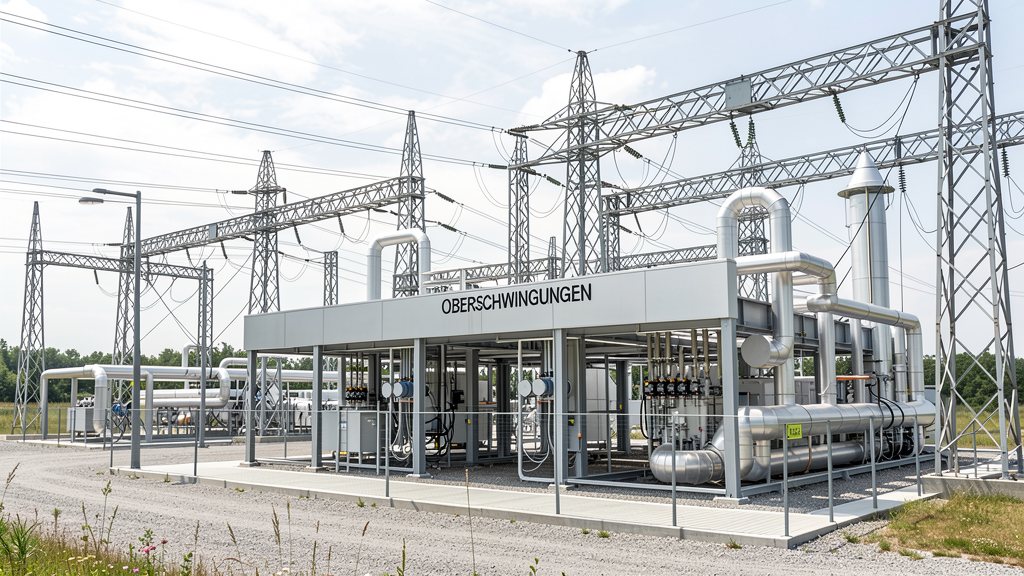
What a harmonic is
In an ideal grid, voltage and current follow a pure 50 Hz sine wave. A harmonic is an additional component that oscillates at a whole-number multiple of that fundamental — 100 Hz, 150 Hz, 250 Hz and so on. When these components add to the fundamental, the resulting waveform is no longer a clean sine but a distorted curve.
Harmonics are not an abstract nuisance: they represent real current and voltage that flows in cables, transformers and connected equipment. The more non-linear loads and power-electronic devices a network contains, the stronger the harmonic content tends to be. This makes harmonics a growing topic as drives, inverters and small feed-in units multiply in operating networks.
Frequency converters as a source
Frequency converters (Frequenzumrichter, FU) are one of the most common industrial sources of harmonics. To vary motor speed, they switch the supply electronically, and in doing so they draw non-sinusoidal currents from the network rather than a smooth sine.
These switching currents appear as harmonics that circulate in the operating network. Because a converter is a permanently connected load, its harmonic emission is continuous during operation — not a one-off event. Where several drives run in the same installation, their contributions add up on shared cables and busbars.
PV plants and inverters
Harmonics are not limited to motor drives. Large photovoltaic power plants also emit harmonics, and this has been documented in measurement-based analyses of installations in the USA, China, Australia and Spain. The inverters that convert DC to AC are the relevant power-electronic components here.
At the small-scale end, plug-in and balcony PV systems (Balkonkraftwerke) add to the picture. Their inverters influence grid quality, and harmonic emission is one of the effects that is easily underestimated — especially where many uncoordinated devices feed into the same low-voltage network without the operator being able to control them centrally. Inverter behaviour on reactive power and power factor (cos φ) varies between cheap and modern units, which affects how much support or disturbance a device contributes.
What harmonics cause
The practical consequences of unmanaged harmonics fall into three groups. First, heat: harmonic currents create additional losses in cables, transformers and motors, raising temperatures beyond what the fundamental alone would produce. Second, malfunctions: distorted voltage can disturb sensitive electronics and control equipment connected to the same network. Third, wear: the extra thermal and electrical stress shortens the service life of the affected components.
Because these effects build up over time and are shared across everything connected to the network, they are often noticed as unexplained warming, nuisance tripping or premature failures rather than being immediately traced back to harmonics.
Measuring harmonics with Stromfee
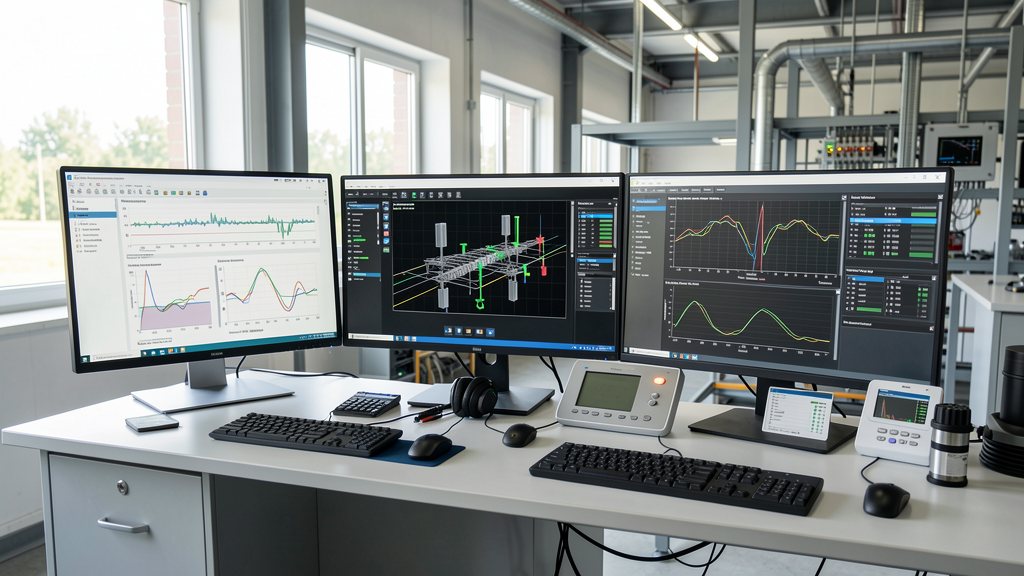
You cannot reduce what you have not measured. Stromfee provides measurement and monitoring technology to record power quality and harmonics directly in the operating network — for example a grid analysis (Netzanalyse) carried out at the switchgear or distribution board.
A live measurement shows the voltage quality and the harmonic content actually present at a given point, rather than relying on assumptions. This turns a diffuse complaint about heat or malfunctions into concrete data about which frequencies are present and where they originate. Stromfee combines this measurement layer with energy-AI to analyse the recorded data and identify the drivers of harmonic distortion in the network.
From analysis to reduction
Reducing harmonics starts with locating and characterising the sources — which drive, inverter or feed-in device contributes what, and where the distortion concentrates in the network. Measurement and analysis provide this basis before any technical countermeasure is chosen.
Because the strongest sources in modern installations are power-electronic — frequency converters and PV inverters — the emphasis is on understanding their emission during real operation. Continuous monitoring also makes it possible to see whether the harmonic situation changes as loads, drives or feed-in units are added, so problems are caught before they translate into heat, faults and wear.
FAQ
What exactly is a harmonic (Oberschwingung)?
It is a current or voltage component that oscillates at an integer multiple of the 50 Hz fundamental frequency and distorts the pure sine wave. Harmonics arise when power-electronic devices draw or feed non-sinusoidal currents into the network.
Why do frequency converters produce harmonics?
To control motor speed, a frequency converter switches the supply electronically and therefore draws non-sinusoidal currents rather than a smooth sine. These switching currents circulate in the operating network as harmonics for as long as the drive runs.
Do PV systems also cause harmonics?
Yes. Measurement-based analyses of large PV power plants in the USA, China, Australia and Spain document harmonic emissions from their inverters. Small balcony PV systems also influence grid quality, and their harmonic contribution is often underestimated, particularly when many uncoordinated units feed the same low-voltage network.
How does Stromfee help with harmonics?
Stromfee provides measurement and monitoring technology to record power quality and harmonics directly in the network — for example a grid analysis at the switchgear — and uses energy-AI to analyse the data and identify the sources of distortion, which is the basis for any reduction.