Why the peak, not the energy, drives the bill
In the German grid-fee structure the demand-charge component (Leistungspreis) is based on the highest measured quarter-hour peak of the billing period. A single high quarter-hour sets the billed capacity (Bemessungsleistung) for the entire period, even if it occurs only once.
The same logic applies to demand charges in general: in an illustrative Stromfee BESS Academy scenario, a facility that peaks at 25 MW instead of 22 MW pays roughly $50,000 more, purely because of that one higher peak. Reducing the peak — not the total consumption — is what lowers this cost.
How a battery shaves the peak
A BESS charges when load is low or power is cheap and discharges into the site's load exactly during the short spikes, so the meter never sees the full peak. The stored energy fills the gap between the site's actual demand and a set threshold.
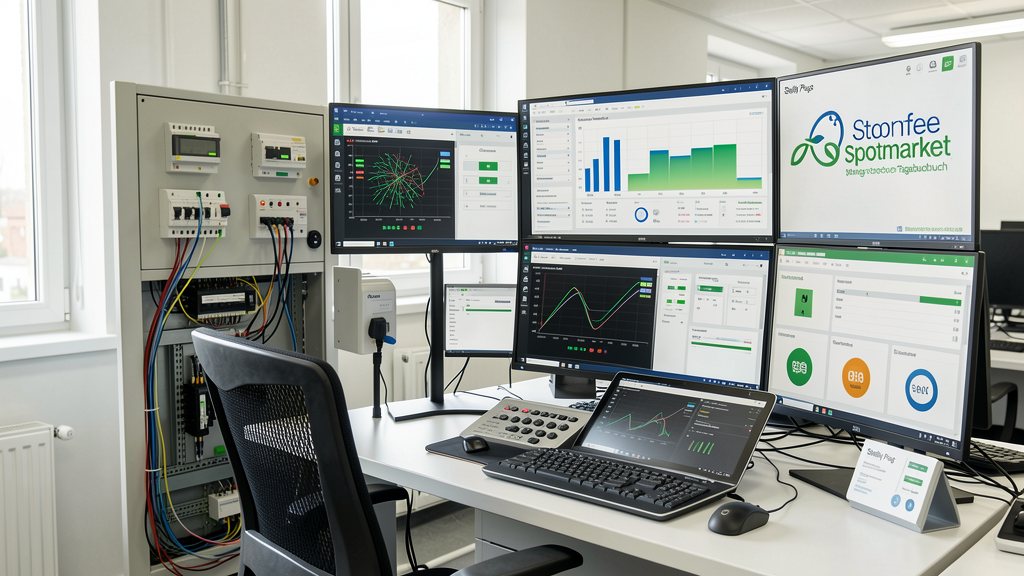
In Stromfee's EMS demand module (Lastspitzen-/Demand-Steuerung), monthly threshold controllers cap the load at a chosen ceiling and can also prevent unwanted power export back into the grid. In the Academy game scenario the target is to hold the site under 22 MW using storage and thermal shifting, illustrating the same threshold-based control principle used in practice.
What peak shaving can save
The savings come from the avoided demand charge plus lower grid fees. In the Stromfee hotel-chain case for Oberstaufen wellness hotels, peak shaving with a BESS is cited as reducing grid costs (Netzentgelte) by up to 35%. The Academy scenario shows a 12,000 kW peak reduction translating into a 38% demand-charge reduction and roughly $34,200 saved per day for a large facility.
These figures are scenario- and site-specific. The actual benefit depends on how pronounced the load peaks are, how often they occur, and how the demand charge is structured in the applicable tariff.
Peak shaving plus day-ahead arbitrage
The same battery that shaves peaks can also arbitrage energy prices. Stromfee's approach charges the BESS cheaply at night and discharges in the expensive evening hours (cited at 25–40 Ct/kWh), with the control AI re-optimizing daily based on the price forecast. In the hotel case this arbitrage is stated to add about +10% additional yield on top of the peak-shaving benefit.
Where rooftop PV is present, surplus generation can be stored instead of exported at a low feed-in rate and used later in the day. A BESS can also provide backup (USV/emergency) power for critical loads such as cold storage, emergency lighting or servers during a grid outage.
Getting the sizing and control right
A battery only shaves peaks it is dimensioned for. Stromfee sizes the BESS by analysing the site's load profile to find the storage capacity and power rating that match the real peaks — avoiding both undersizing (peaks not fully covered) and oversizing.
Beyond capacity, three things must be correct for peak shaving to deliver: the sizing, the load forecast, and the priority logic that decides when the battery discharges. If the forecast misses a peak or the state of charge is spent on arbitrage when a peak arrives, the demand charge is not reduced.
Beyond batteries: complementary peak reduction
Battery storage is one lever among several. Thermal energy storage (TES) — making ice at night and cooling with it by day — shifts the cooling load off the peak window without touching the electrical peak directly. Load shifting moves flexible processes such as laundry or kitchen operation into cheaper, lower-load periods.
In fleet and depot settings, a BESS is integrated to add charging flexibility so that many vehicles charging at once do not create a new demand peak. Combining storage with thermal shifting and load scheduling typically cuts the peak further than any single measure alone.
FAQ
Does peak shaving reduce my energy consumption?
No. Peak shaving reduces the highest measured power peak (kW), which sets the demand-charge and grid-fee component of the bill. Your total energy use (kWh) stays roughly the same — the battery discharges during peaks and recharges at other times.
How much can a battery storage system save on grid fees?
It depends on the site's load profile and tariff. In Stromfee's hotel-chain case, peak shaving with a BESS is cited as reducing grid costs (Netzentgelte) by up to 35%, and an Academy scenario shows a 38% demand-charge reduction. Actual results vary with how pronounced and frequent the peaks are.
Can the same battery do peak shaving and price arbitrage?
Yes, but the control logic must prioritise. Stromfee's AI re-optimises daily: charging cheaply at night and discharging in expensive evening hours (25–40 Ct/kWh) for arbitrage, while reserving state of charge to cover load peaks. In the hotel case, arbitrage adds about +10% additional yield on top of the peak-shaving benefit.
What has to be right for peak shaving to work?
Three things: correct BESS sizing from the site's load profile, an accurate load forecast so peaks are anticipated, and priority logic that keeps enough charge available for the peak. If any of these is off — for example the battery is empty when a peak arrives — the demand charge is not reduced.