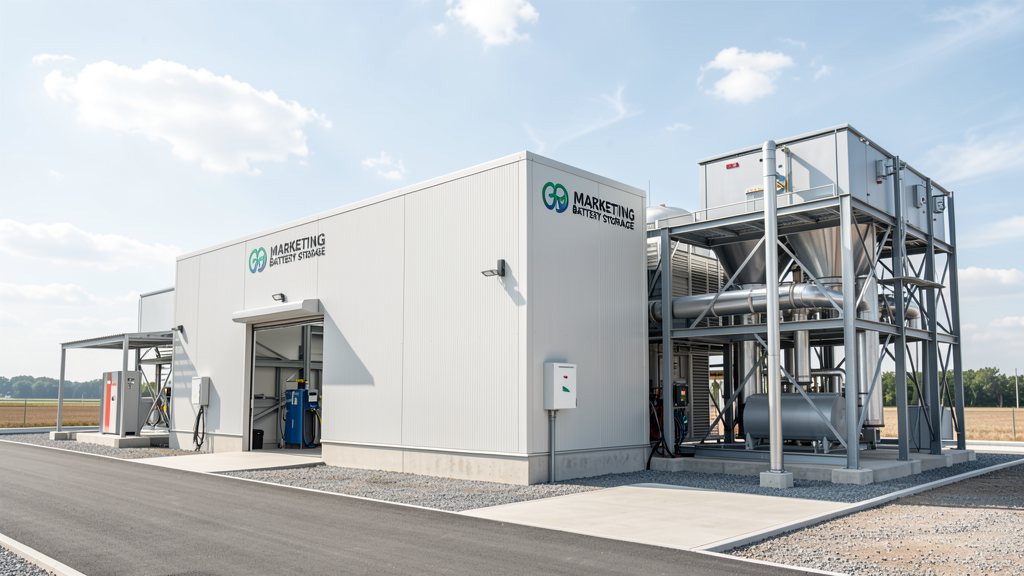
What marketing a battery storage system means
Marketing a battery is not a single product — it is a set of markets across which the asset's charge and discharge cycles are allocated. Stromfee's direct-marketer view breaks this down into 14 markets: five for energy arbitrage, six for balancing reserve, and three covering strategy and context. Each market has its own timing, price signal and access rules.
The core constraint is exclusivity in time: a battery is on only one market per time slice. Every megawatt-hour of capacity that is committed to balancing reserve in a given period cannot at the same time be used for day-ahead arbitrage. Marketing therefore is an allocation problem — deciding which market a given slice of capacity serves so that the planned spread is realised.
The German storage market in 2025
Large-scale storage now drives the German market while home storage stagnates. According to figures from the Bundesverband Solarwirtschaft (BSW-Solar), around 600,000 new stationary battery systems totalling roughly 6.5 GWh went into operation in 2025, a trend confirmed at ees Europe 2025 in Munich.
Within that total the picture diverges sharply: home-storage demand fell by about 8 percent versus 2024, whereas the market for newly installed megawatt-class large storage more than doubled and commercial storage grew by roughly 30 percent. This shift toward grid-scale assets is exactly the segment where market-driven revenue optimisation matters most.
Energy arbitrage on the day-ahead market
Energy arbitrage means buying energy when the price is low and discharging when it is high, capturing the price spread. On the wholesale side this runs through direct marketing at the power exchange rather than through standardised over-the-counter trades.
So-called "sonstige Direktvermarktung" refers to selling electricity by producers or other market participants directly at the exchange, outside the regular exchange trading channels — that is, outside the organised trading platforms. For a battery, the day-ahead auction is a central venue for planning the spread, because prices for each hour of the following day are known in advance and let charge and discharge windows be scheduled.
Balancing reserve and TSO prequalification
Batteries can also earn on the balancing markets, providing frequency containment reserve (FCR / Primärregelung) and automatic frequency restoration reserve (aFRR / Sekundärregelung) in Germany. These products reward the fast, controllable response that battery storage delivers well.
Access is not automatic. A battery must first pass prequalification with its connecting transmission system operator, following the common prequalification conditions of the four German TSOs — 50Hertz, Amprion, TenneT and TransnetBW — published on regelleistung.net. Balancing reserve is then procured on a non-discriminatory basis. Prequalification is therefore a prerequisite before any balancing revenue can be marketed.
Allocating capacity across markets
Because a battery serves only one market per slice, the value of marketing lies in the allocation and mix across all available venues over the day. Stromfee frames this as a menu of markets plus the schedule that connects them — a signal that shows where the money is on a given day.
The practical task is to combine energy arbitrage windows and balancing reserve commitments so that the asset's cycles are directed to the highest-value use available in each period, within the physical limits of the battery and the access rules of each market.
Computing the revenue potential
Stromfee computes the revenue maximum of every battery of at least 1 MW from public data, and separately shows what actually arrives at the asset. Separating the theoretical maximum from the realised result makes it possible to see how much of the potential is being captured and where it is being lost.
This asset-level view is the basis for optimisation: knowing the revenue ceiling of a storage system, and comparing it against realised earnings, turns marketing from a set of isolated market bids into a measured, plannable process.
FAQ
What are the main markets for marketing a battery storage system?
The two core routes are energy arbitrage — buying low and discharging high, including direct marketing at the power exchange such as the day-ahead auction — and balancing reserve, namely FCR (Primärregelung) and aFRR (Sekundärregelung). Stromfee's direct-marketer view organises these into 14 markets: five for energy arbitrage, six for balancing reserve and three for strategy and context.
Can a battery earn on several markets at the same time?
Not in the same time slice. A battery is on only one market per slice, so capacity committed to balancing reserve in a period cannot simultaneously serve day-ahead arbitrage. Marketing is therefore an allocation problem: deciding which market each slice of capacity serves across the day.
What does a battery need to provide balancing reserve in Germany?
It must pass prequalification with its connecting transmission system operator under the common prequalification conditions of the four German TSOs — 50Hertz, Amprion, TenneT and TransnetBW — published on regelleistung.net. Only after prequalification can the battery provide and market FCR or aFRR; procurement is then non-discriminatory.
How does Stromfee determine what a storage asset can earn?
Stromfee computes the revenue maximum of every battery of at least 1 MW from public data, and separately shows what actually arrives at the asset. Comparing this ceiling against realised earnings reveals how much of the potential is captured and where value is lost.