1,000 MW in Ohio: How Google Trains Gemini on Its Own TPU Chips — Without a Single Nvidia GPU

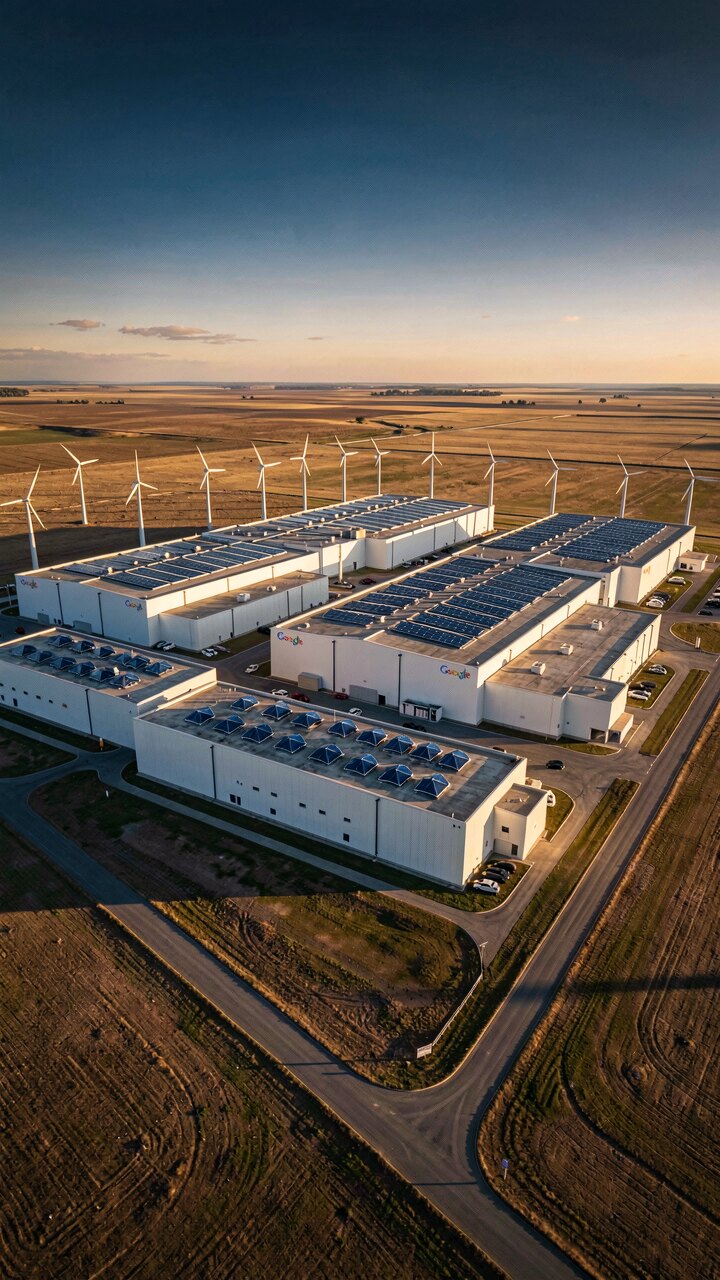
There is no Nvidia logo on this campus. No H100s, no GB200s, no green-badge engineers delivering pallet after pallet of GPU servers. Inside a cluster of low-profile buildings in New Albany, Ohio — a suburb northeast of Columbus that most Americans could not place on a map — Google has assembled what may be the most capable AI training cluster on earth, using hardware nobody else can buy. The chip is called a TPU. And there are hundreds of thousands of them.
Three Campuses, One Logical Machine
Google's Ohio AI Cluster is not a single building. It is a coordinated web of three campuses spread across New Albany, Columbus, and Lancaster — tied together by high-bandwidth fiber that makes them behave as a single, coherent training system. The cluster first came online in 2019 as a general-purpose cloud footprint. What happened next was less a construction project than an arms race: each year, more TPU pods, more cooling towers, more fiber, more power draw. By the end of 2025, the combined campus power target reached 1,000 MW — one full gigawatt, running continuously.
That figure needs context. One gigawatt is roughly the sustained output of a large nuclear reactor. It is also roughly the entire peak electricity demand of a mid-sized European city. Google is spending that amount of power on compute alone — not counting the 100+ MW of cooling, lighting, and infrastructure overhead that surrounds it.
The Numbers
Google does not disclose exact chip counts. What is public: the Ohio cluster runs TPU v4, v5, and v6 hardware — three generations of an accelerator purpose-built for the matrix math at the heart of large language model training. Industry analysts estimate the total installed base at hundreds of thousands of individual TPU cores. Unlike Nvidia's H100 or H200, these chips are not available on the open market. Google designs them, Google manufactures them (via TSMC), and Google is the only customer. That vertical integration is a moat Nvidia cannot easily cross.
In late 2024, Google quietly acquired 618 additional acres near New Albany — land with no immediate construction plan announced. Buying land before you need it is a data center industry signal that rarely goes unexplained. Ohio is not a transitional site. It is a permanent anchor.
Why Ohio? Why TPUs?
Ohio sits on the AEP (American Electric Power) grid — one of the largest utility networks in the eastern United States, capable of delivering gigawatt-scale loads to a single customer. The state also offers cheap land, abundant water for cooling, and a climate that keeps ambient temperatures low enough to reduce chiller load for months each year. Google began evaluating Ohio in 2014; the 2019 opening was not a coincidence.
The TPU decision is a bet that goes back to 2015. Google's engineers had concluded that general-purpose GPU architectures were fundamentally ill-suited to the narrow, repeated matrix multiplications that drive neural network training. They designed a chip that does almost nothing else — and does it with extraordinary efficiency. By the time TPU v6 (codenamed "Trillium") reached Ohio, each generation had delivered roughly 2–3x more compute per watt than its predecessor. The cumulative effect is a training-cost advantage that shapes every Gemini release the world has seen.
Power, Cooling, and What It Means for Energy Managers
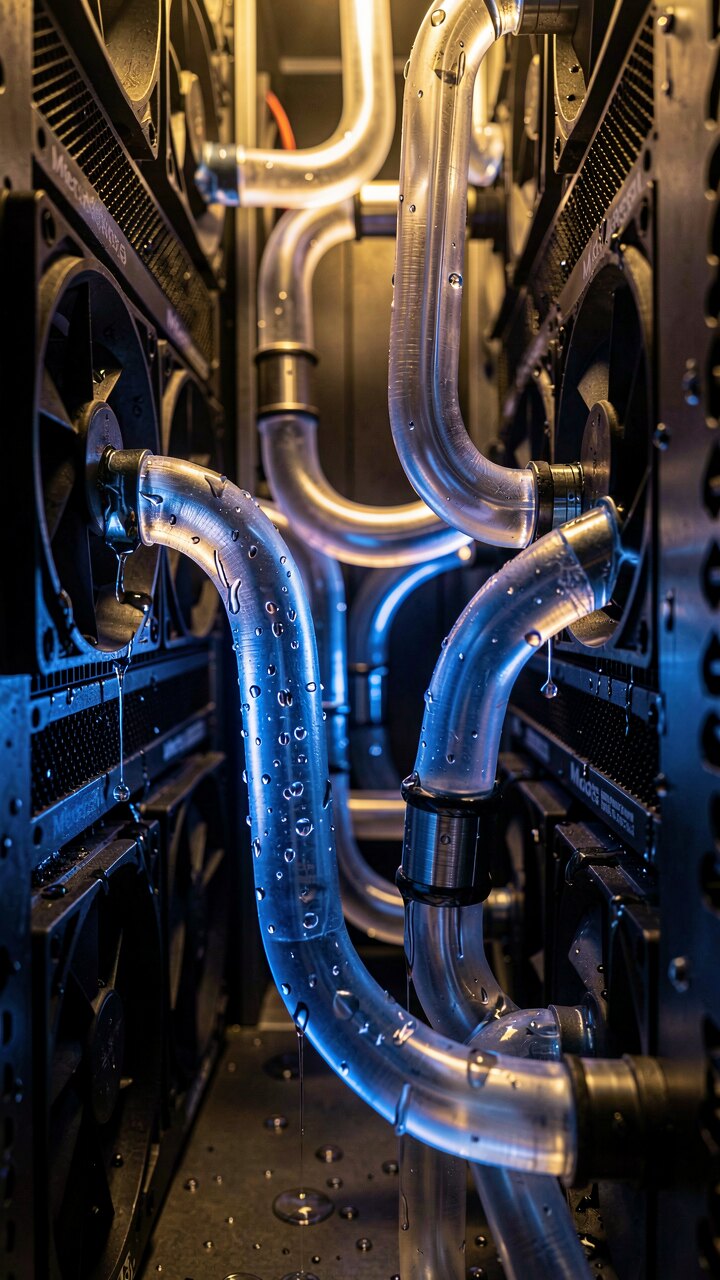
Running 500+ MW of AI compute produces a parallel problem: where does the heat go? Google targets a Power Usage Effectiveness (PUE) of approximately 1.1 at its modern facilities — meaning for every 100 W of compute, only 10 W goes to cooling and overhead. At 1 GW total, that "only 10%" becomes 100 MW of thermal management infrastructure. Chillers, cooling towers, and water distribution loops running around the clock, every day, at a scale that dwarfs most industrial sites.
This is precisely the operational challenge that energy managers at large industrial facilities — BHKW plants, PV parks, commercial buildings — recognize immediately. HVAC and cooling are the largest flexible load in almost any energy-intensive facility. Optimizing when to pre-cool, when to let temperatures rise, and when to shift cooling load into off-peak hours can move cost curves as dramatically as any hardware upgrade.

The Stromfee Connection
Google's Ohio cluster illustrates at extreme scale what every energy-intensive facility already knows at its own scale: the biggest optimization lever is usually not the primary load — it is the cooling and storage infrastructure surrounding it. A 0.05 improvement in PUE at a 1 GW campus saves 50 MW. At a 500 kW industrial site, the same proportional gain saves 25 kW continuously — and at industrial electricity prices, that is real money, year after year.
Stromfee's BESS-Optimizer and transparent HVAC monitoring tools bring the same logic to facilities from 50 kW to 50 MW. Track cooling consumption in real time, model when battery storage should charge versus discharge, and calculate to the cent whether pre-cooling before peak tariff hours beats the cost of running chillers on-peak. Try it at en.stromfee.app.